

0 Views
Department of Seed Science and Technology, S.V. Agricultural College, ANGRAU, Tirupati-517 502.
Sesame (Sesamum indicum L.) is an important oilseed crop valued for its high oil and protein content, widely cultivated in semi-arid tropical regions. Among the various diseases affecting sesame, Alternaria leaf spot caused by Alternaria spp. is a significant constraint, leading to considerable yield losses. This study evaluated the response of 30 sesame genotypes, including germplasm lines, released varieties, and checks, against Alternaria leaf spot under natural field conditions during the kharif 2024 season at S.V. Agricultural College, Tirupati. Disease severity was assessed using the standardized 0-9 rating scale (Mayee and Datar, 1986) at 15-day intervals, and Percent Disease Index (PDI) along with the apparent rate of infection (r) were calculated. Results revealed variation in disease reaction, with no genotypes showing immune or resistant response. Twenty genotypes exhibited tolerance with PDI values ranging from 12.74% to 25.50%, while 10 genotypes were susceptible, with PDI ranging from 27.45% to 44.10%. The highest apparent rate of infection (r = 0.49) was observed in the susceptible check viz., SI- 2174-1, indicating a potential for epidemic development in susceptible genotypes. Disease symptoms initiated around 45 days after sowing and progressed from leaf spots to stem and pod lesions, significantly impacting seed quality and yield. The study highlights considerable genetic variability for Alternaria leaf spot tolerance in sesame germplasm, underscoring the need for incorporating tolerant genotypes in breeding programs. The findings also emphasize the influence of environmental factors and crop management on disease development.
KEYWORDS: Sesame, Alternaria leaf spot, Alternaria spp, Percent disease index, Apparent rate of infection.
Sesame (Sesamum indicum L.), a self-pollinating crop from the Pedaliaceae family, is one of the oldest oilseeds known to humanity. Originally from Africa, it is now widely cultivated across Asia, with India as a major producer. Known as gingelly, til, or benne seed, sesame thrives in semi-arid tropical climates and exhibits excellent drought tolerance due to its deep root system. The seeds are rich in oil (48–55%) and protein (20– 28%), along with essential nutrients and antioxidants like sesamin and sesamol, making them valuable for nutrition and medicine. The stable sesame oil is widely used in food, health, and cosmetic industries.India leads global sesame production, cultivating it on 1039 lakh hectares with an annual yield of 429 lakh tonnes and an average productivity of 413 kg/ha (India Stat, 2023–2024). Major sesame-growing states include Rajasthan, Uttar Pradesh, Madhya Pradesh, Gujarat, and Andhra Pradesh. In Andhra Pradesh, sesame is grown on 0.23 lakh hectares with a production of 0.07 lakh tonnes and productivity of 287 kg/ha, grown in both kharif (rainfed) and rabi (irrigated) seasons. Sesame is vulnerable to several diseases such as charcoal rot, Fusarium wilt, Phytophthora blight, and phyllody, which cause significant yield losses worldwide (Vashisht et al., 2023). Among these, Alternaria leaf spot, caused by Alternaria spp., is a major fungal disease affecting various crops including apples, brassicas, and citrus (Zhang et al., 2021; Dharmendra et al., 2014). In sesame, Alternaria leaf spot begins as small, dark brown to black circular lesions on lower leaves, often surrounded by a yellow halo. As the disease advances, lesions enlarge and form concentric rings, creating a target-like appearance. Severe infections lead to coalesced lesions causing leaf blight, defoliation, and may spread to stems and capsules, reducing plant vigor and seed quality. Alternaria is a diverse fungal genus in the Dematiaceae family, with over 250 species. Species like A. alternata, A. solani, and A. sesami cause leaf spots, blights, and rots on many crops. These fungi produce dark, multicelled conidia, often seed-borne, which aids in disease spread. Given the significant impact of Alternaria on sesame, the following experiment was conducted to evaluate disease reaction among sesame genotypes.
This study was conducted in dry land farm, S.V. Agricultural college Tirupati during kharif 2024. In this study 30 genotypes including, germplasm lines, released varieties and checks were sceened against Alternaria leaf spot disease based on the disease rating scale 0-9 (Mayee and datar 1986). Genotypes SI-25, SI-2174-1 (Check), SI-7650, SI-3264-2, VS-15-007 , AT-324, AT-480 , IS- 1162-13, MT-2019, VS-19-064, IIOS-1101, SI-253-1-C, SI-770, IS-1162-13, SI-1169, AT-336, JCS-RF-2, PT-10, SWETHA TIL, GKVKS-112, IS-208, TBS-6, RT-392, NIC-10621-13, LT-210, IS-475 , TKG 22-4, JCS-DT-26,
VS-19-045, IS-4 were screened in field using RBD randomized block design in two replications keeping SI- 2174-1 as susceptible check, with plant spacing of 30 cm x 10 cm. Each plot has a row length of 3 meters and consists of two rows. The fertilizer dose applied to the crops is 40 kg/ha of nitrogen (N),20 kg/ha of phosphorus (P2O5), and 20 kg/ha of potassium (K2O).
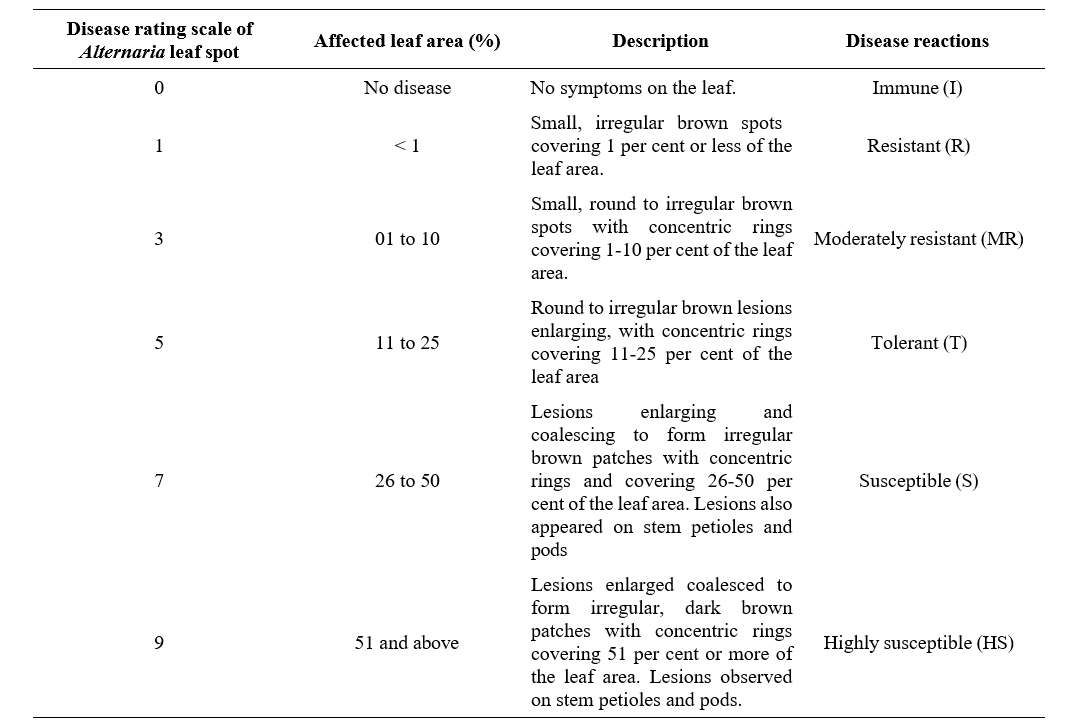
Based on the disease rating scale given, following are the grades for screening the germplasm reaction against Alternaria leaf spot of sesamum.
Disease index (wheeler 1969) of infected germplasm was calculated on sesame plant by observing leaves of 5 random plants per genotype, applying 0-9 grade disease rating scale (Mayee and Datar 1986). Per cent Disease Index (PDI) is calculated by using the below formula. The data was recorded at 15 days interval after commencement of disease.

Apparent rate of infection is a measure of how quickly a disease spreads within a population over time, calculated from successive assessments of disease extent. For the assessment of rate of Alternaria infection in each genotype, the data was recorded at 15 days interval after the commencement of disease to calculate the apparent rate of disease development using the formula suggested by Vander plank (1968). The formula was given below.
Where r is apparent rate of infection in non- logarithmic phase, X1 and X2 symbolizes the percent disease index at time t1 and subsequent week time t2.

For the assessment of disease reaction to seed borne Alternaria spp. in sesame, 30 genotypes (Table 2) were evaluated under natural field infection in randomized block design (RBD). The readings were recorded after commencement of disease for every 15 days interval for each genotype. Five plants were taken randomly and disease reaction was scored based on the disease rating scale 0-9 (Mayee and Datar,1986).
The disease was started appearing from 45th day onwards. Two observations were taken at 60 DAS and 75 DAS and the crop was harvested at 90 days. When the plant is infected with Alternaria spp.in early stage of infection, disease manifests mainly on the leaf blade, as brown, round to irregular spots varying from 1 mm to 2mm in diameter, which later become darker in color with concentric zonation demarcated with brown lines inside the spots on the upper surface. On the lower surface, the spots exhibited greyish brown in color. In severe infections, affected leaves dried and dropped off. Infection on stem exhibited and produces browning and blighting of stem, covering more area while on pods deep seated spots developed and damaged the seed quality causing heavy loss in seed yield. In tolerant genotype the symptoms appeared as leaves showed round to irregular brown lesions that enlarged and developed concentric rings, giving a target-like appearance. Lesions expanded to cover 11-25% of the leaf area, often coalescing and causing necrotic blighted patches with chlorotic halos. In susceptible the symptoms appeared as lesions that enlarged and coalesced to form irregular brown patches with distinct concentric rings, covering approximately 26-50% of the leaf area. In addition to foliar symptoms, similar lesions were observed on petioles and pods.
From the field evaluation of 30 genotypes percent disease index (PDI) values at 60 DAS ranged from 6.06 to 18.41% and at 75 DAS, percent disease index (PDI) values ranged from 12.74 to 44.10% (Table.4.1). SI- 2174-1(susceptible check) which showed highest percent disease index (PDI) values of 16.69% and 44.10% at 60 and 75 DAS respectively. At 60 DAS, highest disease reaction was showed by SI-25 (18.41%) and least disease reaction was observed in genotype VS-19-064 (6.06%). At 75 DAS, highest disease reaction was showed by
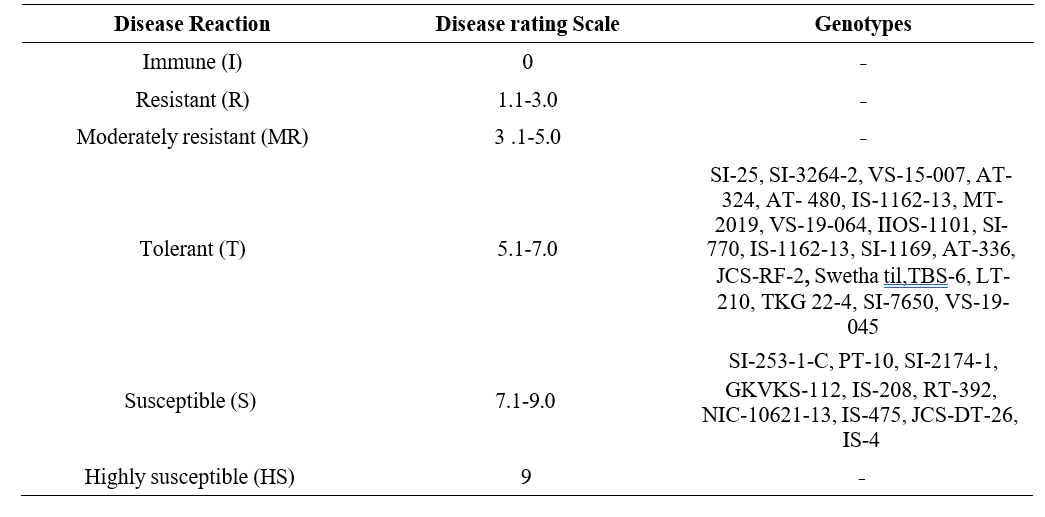
SI-2174-1 (44.10%) and least disease reaction was observed in genotype SI-7650 (12.74%).The results of field screening showed a total of 20 genotypes (SI-25, SI-3264-2, VS-15-007, AT-324, AT-480, IS-1162-13, MT-2019, VS-19-064 ,IIOS-1101, SI-770, IS-1162-13, SI-1169, AT-336, JCS-RF-2, Swetha til,TBS-6, LT-210, TKG 22-4, SI-7650, VS-19-045) have shown tolerant reaction to Alternaria with PDI ranged from 12.74-25.50 (Table 3), while 10 genotypes ( SI-253-1-C, PT-10, SI- 2174-1, GKVKS-112, IS-208, RT-392, NIC-10621- 13, IS-475, JCS-DT-26, IS-4) have shown susceptible reaction to Alternaria with PDI values ranged from 27.45-44.1(Table 3). None of the genotype was immune nor resistant to Alternaria disease reaction under natural conditions.
For assessment of rate of Alternaria infection in each genotype, the apparent rate of infection (r) was
determined as per the procedure described in materials and methods. The disease data was recorded at 15 days interval (60 and 75 DAS) to calculate the apparent rate of disease development using the formula suggested by vander plank (1968). The apparent rate of infection is as showed in (Table 4).
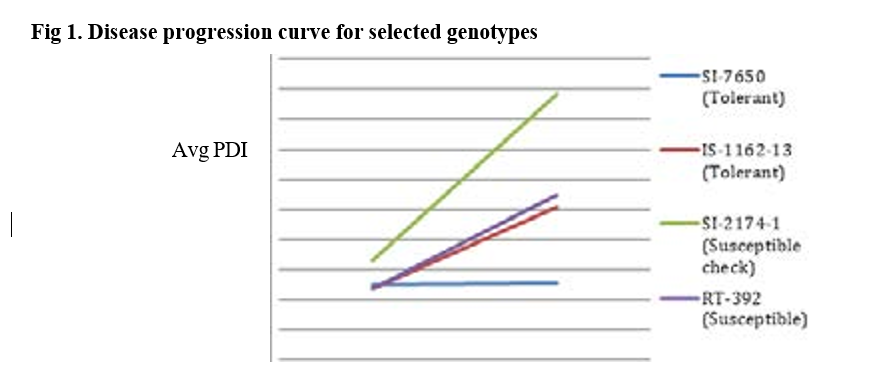
As increase in the rate of Alternaria infection growth, apparent rate of infection was also increased in all genotypes. Hence the chances of epidemics is more in susceptible genotypes of sesame. The apparent rate of infection values ranged from 0.32-0.49. Highest apparent rate of infection was observed in SI-2174-1 (0.49) and least apparent rate of infection was observed in SI-7650 (0.32). The apparent rate of infection noticed in susceptible genotypes such as SI-2174-1(0.49), NIC- 10621-13(0.463), IS-208(0.462), SI-253-1-C (0.45), indicates disease has epidemic rate of infection (Fig. 1). The experiment demonstrated variability in the

resistance levels of sesame genotypes against Alternaria leaf blight, by 66.66% exhibiting tolerance and 33.33 % susceptiblity and none of the genotype showed immune or resistant. This result underscores the genetic diversity in sesame for disease resistance, a critical aspect for breeding programs aimed at enhancing crop resilience.
Environmental factors and crop management practices also play a role in disease development and resistance expression. Warmer temperatures due to climate change might increase the abundance of Alternaria species, potentially affecting resistance levels (Jindo et al., 2021). Additionally, crop development stages, cultivation methods, and field management practices influence the development of early blight disease (Jindo et al., 2021).
Resistance to Alternaria leaf blight in different crops is influenced by various factors: Genetic factors play a crucial role in determining resistance levels. Studies have identified wild relatives of cultivated crops with higher natural resistance to Alternaria species. For instance, wild potato species like Solanum berthaultii and commersonii subsp. malmeanum showed promising resistance against early blight caused by A. solani (Wolters et al., 2021). The resistance in these wild species was inherited in offspring when crossed with cultivated potato, suggesting a genetic basis for resistance.
Plant age and maturity can also influence susceptibility to Alternaria leaf blight. In tomatoes, susceptibility increased as plants matured, with plants being susceptible at all growth stages but becoming more vulnerable as they aged (Vioutoglou & Kalogerakis, 2000). Similar observations were also observed in this study as plants were not effected in the early stages, symptoms were seen fom 45 days in the field.
Ram et al. (2007) reported in linseed that similar trends where a small percentage of genotypes exhibited moderate resistance, while the majority ranged from susceptible to highly susceptible. These alignments reinforce the need for continued exploration of genetic resources to identify and utilize resistant germplasm effectively.
The presence of tolerant genotypes in this study is encouraging for future breeding efforts. However, the susceptibility observed in tested genotypes highlights the urgency to integrate molecular tools such as marker- assisted selection (MAS) and genome-wide association studies (GWAS) to identify resistance genes.
In sesame, Natrajan and Shanmuga (1983) reported that none of the cultivar was resistant to Alternaria sesami. Rani et al. (1985) while working on sesamum against Alternaria alternata reported that no cultivar was

shown resistant reaction. Shekharappa and Patil, (2001) reported that some cultivars showed resistant reaction to Alternaria but none was shown immune to Alternaria. Basavraj et al. (2007) while working on sesame against Alternaria sesame, none of the cultivar showed immune to Alternaria. Similar kind of studies were also reported by Marri et al. (2012) and Pawar et al. (2019).
None of the genotypes demonstrated complete immunity or resistance, highlighting the absence of resistant lines in the tested material. The apparent rate of infection (r) further confirmed a rapid disease progression in susceptible genotypes, indicating potential risk of epidemics. The findings emphasize the need for continuous screening and utilization of tolerant lines in breeding programs. Integrating molecular tools and resistant sources from wild relatives may accelerate the development of resistant sesame cultivars.
Basavaraj MK, Ravindra H, Giresjesh GK, Karegowda C and Shivayogeshwara B. 2007. Evaluation of Sesame genotypes for resistance to leaf blight caused by Alternaria sesami. Karnataka Journal of Agricultural Sciences. 20(4): 864-864.
Dharmendra, K., Chanda, K., Yashwant, K. B., Adesh, K., Raj, K. M., Neelam, M., Sushil, K. S., Ajay, K., Gireesh, C., Kamlesh, K & Kalpana, S. 2014. English. African Journal of Microbiology Research. 8(30): 2816–2829.
Jindo, K., Evenhuis, A., Kempenaar, C., Pombo SudrE, C., Zhan, X., Goitom Teklu, M and Kessel, G.2021. Holistic pest management against early blight disease towards sustainable agriculture. Pest management science. 77(9): 3871-3880.
Marri, N.A., Lodhi, A.M., Hajano, J., Shah, G.S and Maitlo, S.A. 2012. Response of different sesame (Sesamum indicum L.) cultivars to Alternaria leaf spot disease (Alternaria sesami) (kawamura) mohanty & behera. Pakistan Journal of Phytopathology. 24 (2): 129-132.
Mayee, C. D. and Datar, V. V. 1986. Phytopathometry Technical Bulletin-1. Marathwad Agril. Univ., Parabhani, (M.S.) India. 100-104.
Natarajan S and Shanmugam N. 1983. Screening of sesame germplasm for resistance to Alternaria leaf
blight. National Seminar on Breeding crop plants for resistance to pests and diseases. Tamil Nadu Agricultural University, Coimbatore, 25-27th May, 1983.
Pawar DV, Suryawanshi AP and Kadam VA. 2019. Screening of sesame varieties, cultivars, germplasm lines and elite lines against Alternaria sesami. International Journal of Current Microbiology and Applied Sciences 8(12): 534-541.
Ram, K.R.K., Srivastava, R.K & Singh, P. 2007. Screening of linseed genotypes for seed yield against Alternaria blight. International Journal of Plant Science. 2(2): 68-69.
Rani, V. U., T. S. Lingam and V. Thirupathaiah. 1985. Bending of stem in sesame – a new symptom caused by Alternaria alternata. Indian Journal Mycology and Plant Pathology. 14(1): 98-99.
Shekharappa, G and P.V, Patil. 2001. Chemical control of leaf blight of sesame caused by Altemaria sesami. Karnataka Journal of Agricultural Sciences. 14(4): 1100- 1102.
Vander plank, J.E. 1968. Disease resistance in plants. Academic Press, New York.
Vashisht, P., Yadav, N. K., Kumar, R., Jangra, P & Indora, 2023. Management Strategies for Charcoal Rot of Sesame: A Review. International Journal of Plant & Soil Science. 35(19): 2255–2264.
Vioutoglou, I and Kalogerakis, S.N. 2000. Effects if inoculum concentration, wetness duration and plant age on development of early blight (Alternaria solani) and on shedding of leaves in tomato plants. Plant Pathology. 49(3): 339.
Wolters, P.J., Wouters, D., Kromhout, E.J., Huigen, D.J., Visser, R.G and Vleeshouwers, V.G. 2021. Qualitative and quantitative resistance against early blight introgressed in potato. Biology. 10(9): 892.
Zhang, Q., Fan, W., Wei, H., Xu, C., & Li, T. (2021). Two pathogenesis-related proteins interact with leucine- rich repeat proteins to promote Alternaria leaf spot resistance in apple. Horticulture Research. 8(1).