
0 Views
Department of Agronomy, S.V. Agricultural College, ANGRAU, Tirupati-517 502.
A field experiment was conducted during summer, 2025 at S.V. Agricultural College Farm, Tirupati. The experiment was laid out in split-plot design and replicated thrice. The treatments consisted of three irrigation regimes viz., IW/CPE-0.6 (I1), IW/CPE-0.8 (I2) and IW/CPE-1.0 (I3) assigned to main plots and four nitrogen levels viz., control (N1), 40 kg N ha-1 (N2), 60 kg N ha-1 (N3) and 120 kg N ha-1 (N4) allotted to sub plots. The results of the study revealed that significantly higher dry matter production, seed yield and uptake of N, P and K by sesame was recorded with scheduling of irrigation at IW/CPE-1.0. Application of 120 kg N ha-1 resulted in significantly higher dry matter production, seed yield and uptake of N, P and K by sesame crop and the lower nutrient uptake of N, P and K by sesame crop was registered with control. Scheduling of irrigation at IW/CPE-1.0 along with application of 120 kg N ha-1 resulted in higher dry matter production, seed yield and uptake of N, P and K by sesame crop.
KEYWORDS: Irrigation regimes, IW/CPE, Nitrogen levels, Sesame.
Sesame (Sesamum indicum L.) is an important oilseed crop cultivated in India. The crop is more commonly referred as ‘Queen of Oilseeds’ which contains 50-60% oil, 8% protein, 5.8% water, 3.2% crude fiber, 18% carbohydrates, 5.7% ash and it is very rich in minerals such as calcium, phosphorus and vitamin E. Globally, India is the largest sesame producer and it is cultivated in an area of 15.23 lakh hectares with a production of 8.47 lakh tonnes and productivity of 553 kg ha-1 during 2023-24. In Andhra Pradesh, sesame is grown over an area of 0.31 lakh hectares with an annual production of 0.11 lakh tonnes and productivity of 376 kg ha-1 (www.indiastat.com, 2023-24). Irrigation is of great importance to sesame production due to it’s positive effect on flowering and capsules formation. Water stress limits sesame growth and development. Besides meeting water requirement of crop plants, supply of irrigation water may cause considerable changes in availability of plant nutrients in soil through stimulation of microbial activities and dissolution of salts. Hence, assured water supply through efficient irrigation practice is an essential basic input for obtaining higher yield. Nitrogen plays a key role as it is a constituent of protein, nucleic acid and chlorophyll. It also plays an important role in synthesis of chlorophyll and amino acids that contributes to the building unit of protein and thus growth of plants. An adequate supply of nitrogen is essential for vegetative growth and desirable yield. On the other hand, excessive application of nitrogen is not only uneconomical, but it can also prolong the growing period and delay the crop maturity. Among agronomic interventions, the two most crucial inputs boosting the seed yield and quality of summer sesame are irrigation and nitrogen. However, the limited work done on this aspect for white sesame does not provide a comprehensive information on its irrigation and nitrogen requirement for summer season.
The field experiment was conducted at S.V. Agricultural College, Tirupati campus of Acharya N.G. Ranga Agricultural University, Andhra Pradesh during summer, 2025. The soil of experimental field was sandy loam in texture, neutral in reaction, low in organic carbon (0.26%) and available nitrogen (187 kg ha-1), medium in available phosphorus (27.3 kg ha-1) and available potassium (197.5 kg ha-1). The experiment was laid out in split-plot design and replicated thrice. The treatments consisted of three irrigation regimes viz., IW/CPE-0.6 (I1), IW/CPE-0.8 (I2) and IW/CPE-1.0 (I3) assigned to
main plots and four nitrogen levels viz., control (N1), 40 kg N ha-1 (N2), 60 kg N ha-1 (N3) and 120 kg N ha-1 (N4) allotted to sub plots. The crop period (January to April) was characterized by the weekly mean maximum temperature during the crop growth period ranged from 29.8 to 39.2°C and weekly mean minimum temperature during the crop period ranged from 12.8 to 23.6°C. Total amount of 2 mm of rainfall was received during the crop growth period. “Swetha Til” was used as a test variety and sown at a spacing of 30 cm x 15 cm with a seed rate of 5 kg ha-1. The crop was sown on 23-01-2025 and harvested on 26-04-2025 during the study period. Two common irrigations of 50 mm each were given, one at post sowing for emergence and second at 8th day after sowing for crop establishment. Thinning and gap filling were done at 15 days after sowing. Scheduling of irrigation was started whenever the cumulative pan evaporation (CPE) reached the value of 83.3, 62.5 and 50 mm in I1, I2 and I3 treatments. A common dose of 20 kg P2O5 and 20 kg K2O ha-1 was applied basally. Nitrogen was applied in two equal split doses i.e, as basal and at 25 DAS as per the treatments. The other recommended cultural and pest management practices were adopted.
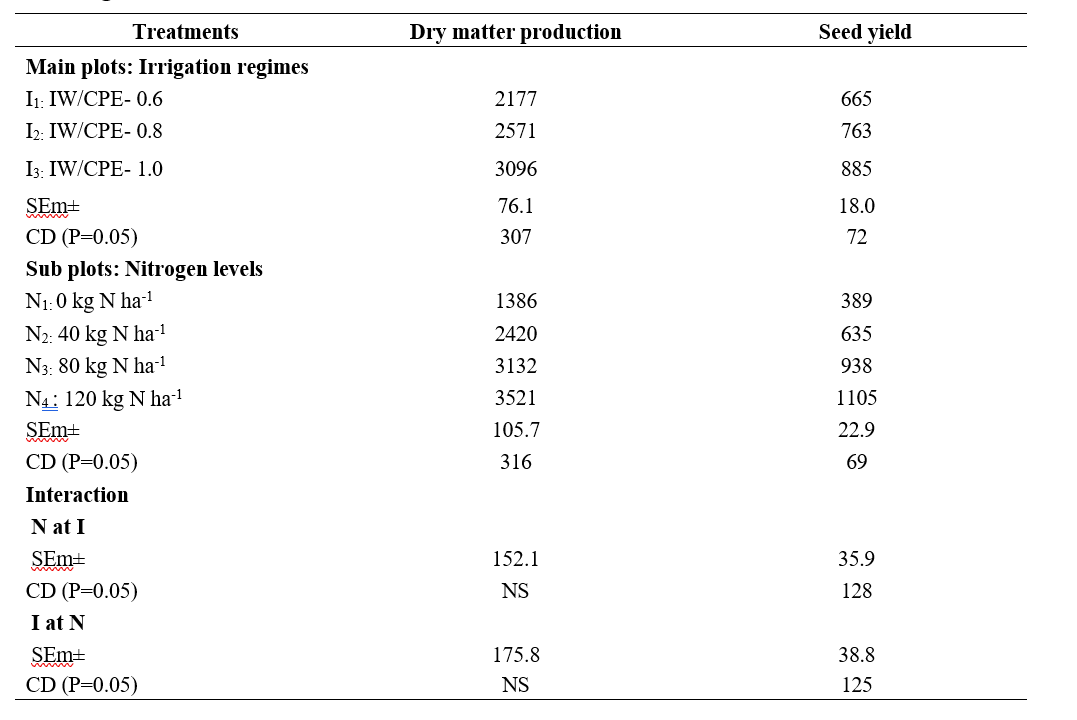
Higher dry matter production was recorded with irrigation scheduled at IW/CPE ratio of 1.0 followed by that with IW/CPE ratio of 0.8 and IW/CPE ratio of 0.6 in the order of descent with significant disparity between each other. This might be due to optimum soil moisture availability favouring the nutrient uptake attributing to increased plant height and leaf area maintained throughout the crop period resulting in enhanced synthesis, which ultimately led to higher dry matter production. Similar findings were reported by Reddy et al. (2010) and Tripathy and Bastia, (2012). Dry matter production of sesame was found to be significantly higher with application of 120 kg N ha-1 than with 80
kg N ha-1. The next best nitrogen level was 40 kg ha-1. It could be attributed to the fact that due to higher leaf area with greater photosynthetic activity together result in increased dry matter accumulation at higher level of nitrogen. These findings were in close conformity with those of Reddy et al. (2010). Significantly lower dry matter production was observed with control.
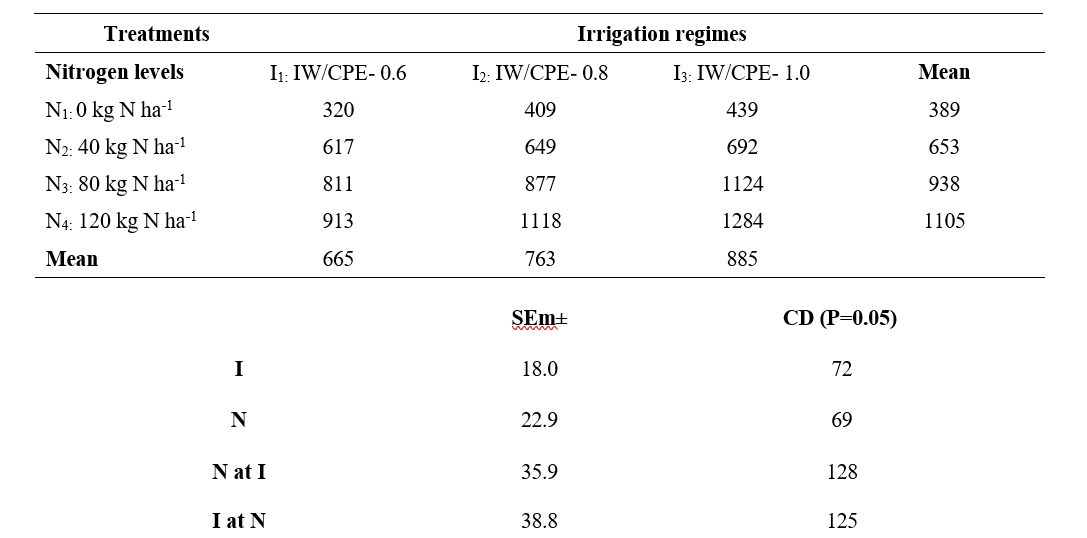
Higher seed yield of sesame was recorded with the scheduling of irrigation at IW/CPE ratio of 1.0, which was significantly superior than the other irrigation regimes tried. This was followed by IW/CPE ratio of 0.8, which was significantly superior to that of IW/ CPE ratio of 0.6, which recorded the lower seed yield. Higher seed yield due to irrigation might be accounted to their favourable influence on the crop growth and yield attributes. These findings were in line of the findings of Reddy et al. (2010).
With regard to the varied nitrogen levels, application of 120 kg N ha-1 resulted in significantly higher seed yield. The next best nitrogen level was 80 kg N ha-1, which was significantly superior to that of 40 kg N ha-1. The lowest seed yield was observed with control. Better availability of nitrogen with application of 120 kg N ha-1 might have enhanced the total biomass accumulation and its efficient translocation from source to sink which resulted in elevated growth parameters (Plant height, dry matter production and leaf area index) and yield attributes (number of branches plant-1, number of capsules plant-1, weight of seeds capsule-1 and test weight) and hence the seed yield. Similar results were also reported by Jamdhade et al. (2017). The interaction effect due to irrigation regimes and nitrogen levels practices was found to be significant. Scheduling of irrigation at IW/CPE ratio of 1.0 along with 120 kg N ha-1 resulted in the highest seed yield. These might be due to the better availability of nutrients under higher soil moisture and at high nitrogen conditions which might have increased the crop growth and translocation of photosynthates from source to sink. Interaction effect between irrigation regimes and nitrogen levels with respect to seed yield were in conformity with the findings of Reddy et al. (2010). The lowest seed yield was recorded with scheduling of irrigation at IW/CPE ratio of 0.6 along with control (I1N1).
Nutrient uptake by plant at harvest was found to be significantly influenced by irrigation regimes and nitrogen levels. The interaction effect of irrigation regimes and nitrogen levels on nitrogen uptake was found significant, while phosphorus and potassium uptake were not statistically significant. The higher nutrient
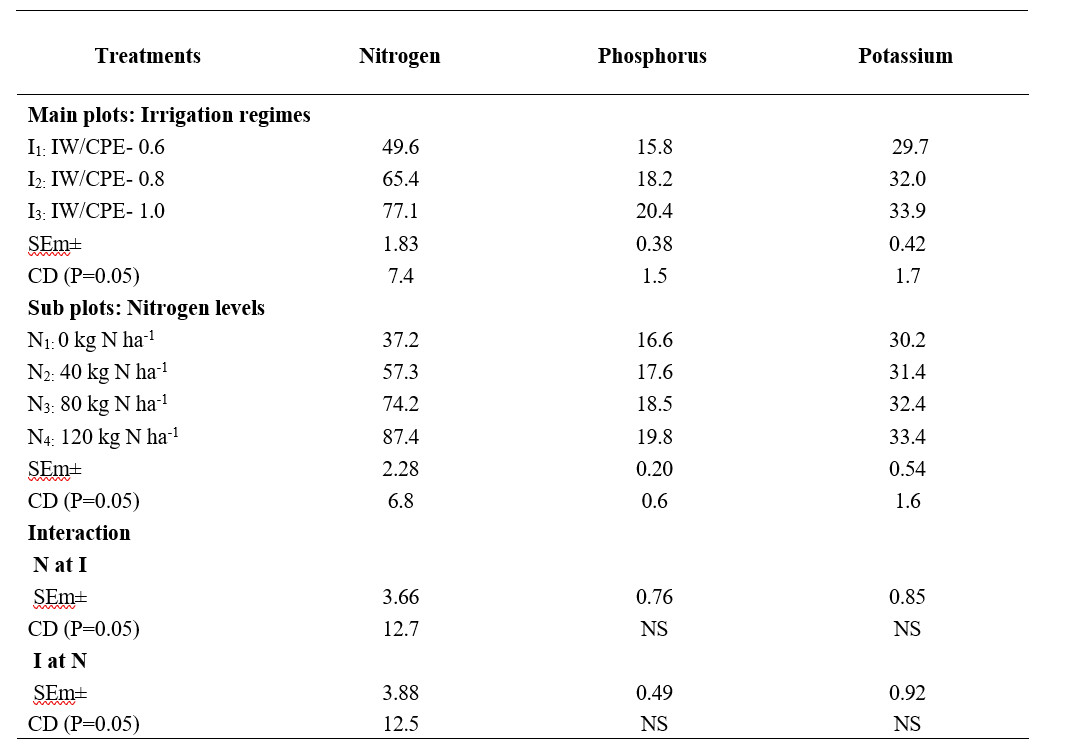
(nitrogen, phosphorus and potassium) uptake at harvest was observed with the scheduling of irrigation at IW/CPE ratio of 1.0, which was significantly higher than the other irrigation regimes tried. This might be due to optimal air and water balance in the soil, which consequently increased the mobilization of the nutrients along with the absorbed water through well-developed root system. This was followed by IW/CPE ratio of 0.8, which was significantly superior to that of IW/CPE ratio of 0.6, which recorded significantly lower nutrient uptake. The results demonstrate that the uptake of N, P and K was recorded higher, when the crop was irrigated at IW/CPE ratio of 1.0. At lower irrigation frequency, insufficient soil water might not have facilitated mass flow, root interception and diffusion processes to mobilize the nutrients for uptake. The uptake pattern mostly followed the biomass yield trend. The results were in conformity with the findings of Tripathy and Bastia, (2012) and Dutta et al. (2015). With regard to nitrogen levels tried, application of 120 kg N ha-1 resulted in higher nutrient (nitrogen, phosphorus and potassium) uptake, which was significantly superior than with 80 kg N ha-1. The later was in turn significantly superior to that of 40 kg N ha-1. Significantly lower nutrient uptake was noticed with control. Application of 120 kg N ha-1 might have improved the microbial activity through enhanced root exudates and increased translocation of nutrients which might have contributed to higher nitrogen, phosphorus and potassium contents respectively in the plant tissue which were further being complemented with their higher dry matter production. These results were in accordance with the findings of Sarkar et al. (2010), Patel et al. (2014) and Chauhan et al. (2016). The interaction effect of irrigation regimes and nitrogen levels on nitrogen uptake was found to be significant. The highest nitrogen uptake was recorded with scheduling of irrigation at
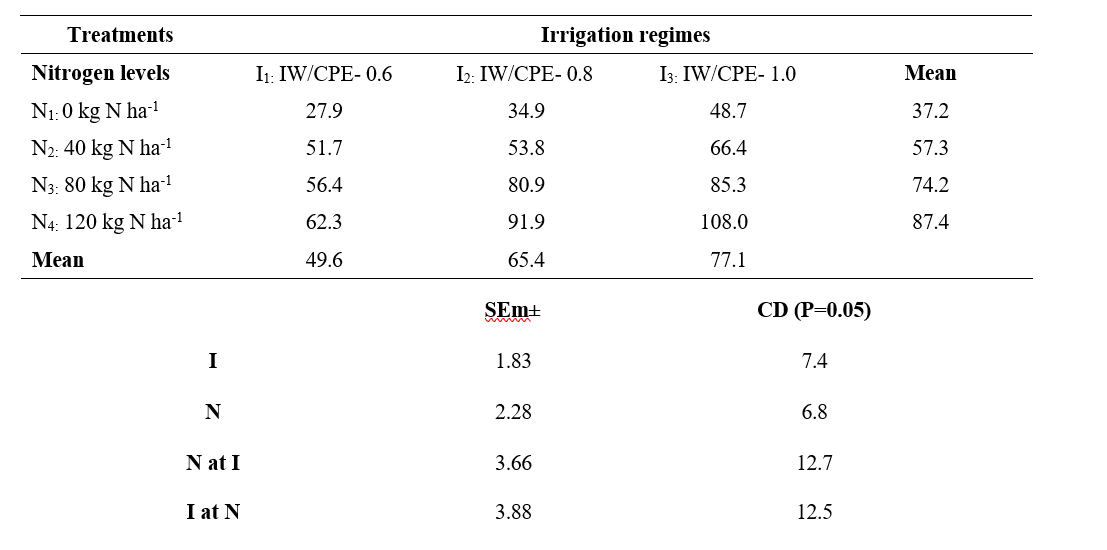
IW/CPE ratio of 1.0 along with 120 kg N ha-1 and the lowest nitrogen uptake was recorded with scheduling of irrigation at IW/CPE ratio of 0.6 along with control.
Scheduling of irrigation at IW/CPE-1.0 along with 120 kg N ha-1 resulted in higher dry matter production, seed yield and NPK uptake by sesame at harvest during summer on sandy loam soils of Southern Agro-Climatic Zone of Andhra Pradesh.
Chauhan, S., Rao, V. P., and Reddy, A. P. K. 2016. Response of sesame (Sesamum indicum L.) to irrigation scheduling based on climatological approach and N fertigation levels. Journal of Oilseeds Research. 33(1): 38-44.
Dutta, D., Mudi, D.D., Murmu, P and Thentu, T.L. 2015. Response of groundnut (Arachis hypogaea) to irrigation schedules, sulphur levels and sources in alluvial zone of West Bengal. Indian Journal of Agronomy. 60(3): 443-449.
Jamdhade, K., Chorey, A., Tijare, B and Bhale, V.M. 2017. Influence of irrigation regimes and nitrogen levels on growth, yield and economics of summer sesame.
International Journal of Current Microbiology and Applied Sciences. 6(3): 2389-2393.
Patel, H. K., Patel, R.M., Desai, C.K and Patel, H.B. 2014. Response of summer sesamum (Sesamum indicum L.) to different spacings and levels of nitrogen under north Gujarat condition. International Journal of Agricultural Sciences. 10(1): 336-343.
Reddy, M.M., Padmaja, B and Reddy, D.R.R. 2010. Response of summer sesamum to irrigation scheduling and nitrogen levels under drip irrigation. The Andhra Pradesh Journal of Agricultural Sciences. 57(2): 131-135.
Sarkar, A., Sarkar, S., Zaman, A. and Rana, S.K. 2010. Performance of summer sesame (Sesamum indicum L.) under different irrigation regimes and nitrogen levels. Indian Journal of Agronomy. 55(2): 143-146.
Tripathy, S and Bastia, D. K. 2012. Irrigation and nutrient management for yield augmentation of summer sesame (Sesamum indicum L.). Journal of Crop and Weed. 8(2): 53-57.