

0 Views
Department of Agronomy, S.V. Agricultural College, ANGRAU, Tirupati-517 502.
A field experiment was conducted during rabi, 2024-25 at Agricultural Research Station, Nellore, Andhra Pradesh. The experiment was laid out in split-plot design and replicated thrice. The treatments consist of five dates of transplanting viz., II F.N of November (D1), I F.N of December (D2), II F.N of December (D3) I F.N of January (D4) and II F.N of January (D5) assigned to main plots, three varieties RNR 15048, KNM 1638 and NLR 34449 allotted to sub plots. Among the varied dates of transplanting tried, higher plant height and dry matter production at harvest was recorded with II F.N of December (D3) whereas, crop transplanted during II F.N of November (D1) registered lower plant height and dry matter production. Incase, of leaf area index the crop transplanted during I F.N of January recorded higher leaf area index. With respect to varieties NLR 34449 (V3) recorded recoded higher leaf area index and dry matter production whereas, RNR 15048 (V1) recorded higher plant height.
KEYWORDS: Rice, times of transplanting, varieties.
Over half of the world’s population depends on rice (Oryza sativa L.), making it a staple meal. These days, rice (Oryza sativa L.) is progressively taking the lead in global dietary patterns. For hundreds of millions of people in Africa and Latin America, as well as the rural population in subtropical and tropical Asia, it is their primary source of income. The world’s rice cultivated area is 168 million hectares. India ranks first in the world with an area of 47.9 million hectares under rice cultivation with production of 137.5 million tonnes and the average productivity of 3155 kg ha-1 (www. indiastatistica.com, 2024-25). In Andhra Pradesh, rice crop is grown in 2.16 million hectares of area with production of 7.49 million tonnes and productivity of 3896 kg ha-1 (www.angrau.ac.in,2025). Timely planting plays a crucial role in ensuring the attainment of superior yield-attributing parameters and ultimately higher grain yield. In contrast, delayed transplanting often leads to a reduction in growth and yield components such as leaf area, number of productive tillers and test weight. This is primarily due to a shortened growth duration and suboptimal environmental conditions during critical growth stages. Photo and thermo-sensitive rice varieties possess physiological traits that cause their growth and reproductive development to respond significantly to variations in day length (photoperiod) and temperature.
The field experiment was conducted at Agricultural Research Station, Nellore of Acharya N.G. Ranga Agricultural University which is geographically situated at 14.27°N latitude and 79.59°E longitude with an altitude of 20m above mean sea level in the Southern Agro-Climatic Zone of Andhra Pradesh. The soil of experimental field was clay loam in texture, alkaline in soil reaction, medium in organic carbon (0.62%), low in available nitrogen (188 kg ha-1), medium in available phosphorus (43 kg ha-1) and available potassium (231 kg ha-1). The experiment was laid out in split-plot design and replicated thrice. The treatments consisted of five dates of transplanting viz., II F.N of November (D1), I
F.N of December (D2), II F.N of December (D3) I F.N of January (D4) and II F.N of January (D5) assigned to main plots, three varieties RNR 15048, KNM 1638 and NLR 34449 allotted to sub plots. A total rainfall of 65.4 mm received in 2 rainy days during the crop growing period. All the other recommended practices were adopted as per the recommendations.
Plant height at harvest was influenced by the times of transplanting and the varieties. The crop transplanted during the II fortnight of December (D3) registered higher plant height than all other transplanting dates, which was
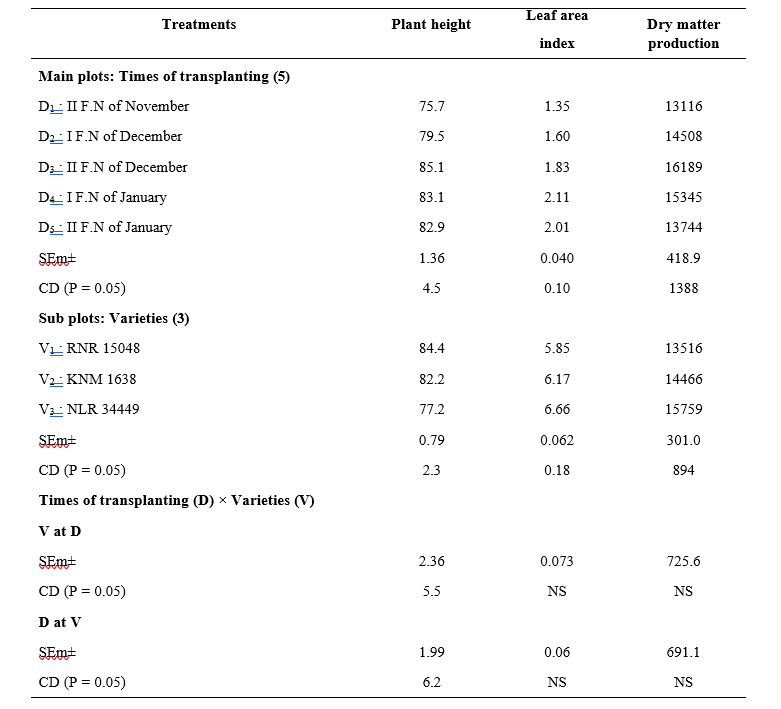
on par with I fortnight of January (D4), II fortnight of January (D5) and I F.N of December (D2). The lowest plant height was observed in the crop transplanted during II F.N of November (D1). Among the varieties tested RNR 15048 (V1) registered higher plant height at harvest which was on par with KNM 1638. While the shortest plant height was recorded with the variety NLR 34449 (V3). With regard to interaction effect RNR 15048 transplanted during II fortnight of December (D3V1) was on par with the variety KNM 1638 transplanted during II fortnight of December (D3V2). The lowest plant height was recorded with the variety NLR 34449 transplanted during II fortnight of November (D5V3) The higher plant height of the variety RNR 15048 (V1) might be due to the genetic character of the variety and higher photosynthetic efficiency. These results were similar to those obtained by Anil and Siddi (2020), Nizamani et al., (2014) and Suleiman et al., (2014) who observed that plant height differed significantly among the varieties.
Among all times of transplanting, the crop transplanted during I F.N of January (D4) recorded significantly the highest leaf area index at harvest, it was followed by the crop transplanted during II fortnight of December (D5) and it was on par with crop transplanted during II F.N of December (D3) followed by the crop transplanted during II F.N of December (D2) and II F.N of November (D1) .While the crop transplanted during II F.N of November (D1) recorded significantly the lowest leaf area index. With respect to varieties RNR 15048 (V1) and NLR 34449 (V3) recorded higher leaf area index followed by KNM 1638 (V2). Higher leaf area index recorded across the dates of transplanting might be due to vigorous growth habit, higher tillering ability and greater leaf production potential were noticed in NLR 34449 (V3) rice variety. With regard to interaction effect, at harvest was found to be non-significant.
Dry matter production of rice at harvest was significantly influenced by times of transplanting and varieties. Among varied times of transplanting, significantly higher dry matter production of rice was recorded when the crop transplanted during II fortnight of December (D3) which was statistically on par with I fortnight of January (D4). Significantly the lower dry matter production was recorded at II fortnight of November (D1).
Significantly highest dry matter production was registered with variety NLR 34449 (V3) followed by KNM 1638 (V2). Significantly the lowest dry matter production was recorded in RNR 15048 (V1). These findings were in line with Sharma et al., (2018)
Interaction effect between times of transplanting and varieties on dry matter production at harvest was found to be statistically not significant. Dry matter accumulation in the plant is a reliable indicator of overall growth, as it integrates various growth parameters over time. Significantly the highest dry matter accumulation was recorded with the crop transplanted during II fortnight of December (D3), which may be attributed to timely transplanting that allowed optimal temperature, interception of solar radiation, along with optimum day length, better vegetative growth under favourable conditions. These factors collectively promote the

synthesis and efficient translocation of photosynthates to vegetative organs, thereby contributing to increased biomass.
Among the varieties evaluated, NLR 34449 (V3) exhibited significantly the highest dry matter accumulation. This superior performance may be attributed to its inherent genetic potential for enhanced photosynthetic efficiency, leading to an increased source capacity and more efficient translocation of photosynthates to the sink. Variations in dry matter accumulation among the different varieties could be attributed to their genetic potential as well as differences in height and growth rates. The results were in-line with the findings of Anil and Siddi (2020) and Dileep et al., (2018).
Among all dates of transplanting the crop transplanted during II fortnight of December recorded significantly higher plant height and dry matter production whereas, the lowest plant height, leaf area index and dry matter production was recorded with the crop transplanted during II fortnight of November. Among varieties RNR 15048 recorded significantly higher plant height. NLR 34449 recorded higher leaf area index and dry matter production.
Anil, D and Siddi, S. 2020. Performance of pre released rice (Oryza sativa L.) genotypes under different sowing windows in rabi season. International Journal of Environment and Climate Change. 10(10): 43-51.
Dileep, K., Pasupalak, S and Baliarsingh, A. 2018. Effect of establishment methods and sowing time on growth and yield of rice varieties (Oryza sativa L.). The Pharma Innovation Journal. 7(4): 904-907.
Nizamani, G.S., Imtiaz, A.K., Abdula, K., Siddiqui, M.A., Nizamani, M.R and Khaskheli, M.I. 2 0 1 4 . Influence of different row spacing on agronomic traits in different wheat varieties. International Journal of Development Research. 4(11): 2207- 2211.
Sharma, N., Murty, N.S., Mall, P and Bhardwaj, S.B. 2018. An analysis on the yield and yield contributing characters of rice in tarai region of Uttarakhand. International Journal of Chemical Studies. 6(3): 42-47.
Suleiman, A.A, Nganya, J.F and Ashraf M.A. 2014. Effect of cultivar and sowing date on growth and yield of wheat (Triticum aestivum L.) in Khartoum, Sudan. Journal of Forest Products & Industries. 3(4): 198-203.
www.angrau.ac.in, 2025.
www.indiastatistica.com, 2024-25. Area, production and productivity of rice. Ministry of agriculture and farmers welfare.