
0 Views
Department of Genetics and Plant Breeding, S.V. Agricultural College, ANGRAU, Tirupati-517 502.
A study was conducted in 44 sesame accessions to analyze genetic variability and character association for yield improvement in sesame. Analysis of variance indicated the existence of significant genotypic differences among the genotypes. High GCV and PCV were observed for seed yield per plant, harvest index and number of capsules per plant. High heritability coupled with high genetic advance as percent of mean was observed for number of primary branches, seed yield per plant, number of capsules per plant, harvest index and height to first capsule indicating the influence of additive and gene action. Seed yield per plant showed positive association with number of capsules per plant, harvest index, oil content and number of primary branches.
KEYWORDS: Sesame, PCV, GCV, heritability, genetic advance as per cent mean, correlation.
Sesame (Sesamum indicum L., 2n = 26), an ancient oilseed crop, a member of the Pedaliaceae family and also known as the “Queen of Oilseeds,” is recognized for its nutritional value and diverse applications. The seeds are rich in proteins, lipids, and lignin-like compounds, offering health benefits such as antioxidant properties, cholesterol reduction, and protection against cardiovascular diseases (Wei et al., 2022). Sesame seeds enhance plasma g-tocopherol and vitamin E activity, which may prevent aging-related diseases, and are incorporated in foods like bread, cookies, and tahini (Elleuch et al., 2011).
In India, it occupied in an area of 10.39 lakh hectares with 4.29 lakh tonnes of production and productivity of 413 kg/ha (Indiastat,2024). Variation in climatic and edaphic conditions affects sesame yield, the major constraints identified in growing sesame are instability in yield, lack of wider adaptability and non-synchronous maturity etc. Therefore, there is a need to exploit the existing genetic variability in sesame for developing high yielding varieties. Besides this, for understanding the mode of inheritance of the yield components, the correlation among them and the association between each component and yield is necessary for intelligent choice of breeding procedures for evolving high yielding varieties. (Robinson et al., 1951 and Johnson et al., 1955).
The present investigation was conducted to study the phenotypic and genotypic variability among the genotypes and to estimate genetic advance, correlation coefficient among the component characters on yield of sesame.
The experiment was conducted with 44 accessions including 40 advanced breeding lines and four checks viz., YLM 66, Swetha til, TKG 22 and G Til 10 in a randomized block design (RBD) with two replications at the Regional Agricultural Research Station (RARS), Tirupati during Rabi 2023-24. Each breeding line was sown in two rows of three meters length with a spacing of 30 cm between the rows and 15 cm distance between the plants within the row. List of forty advanced breeding lines along with four checks utilized are given in Table.1
Observations were recorded for all the characters separately on randomly chosen five competitive plants in each replication except days to 50% flowering and days to maturity which will be taken on plot basis. The characters studied are viz., days to 50% flowering, days to maturity, plant height (cm), number of primary branches per plant, SCMR (SPAD Chlorophyll meter reading), SLA (Specific Leaf Area) (cm2g-1), height to the first capsule (cm), distance between the internodes (cm), number of capsules per plant, capsule length (cm),

number of seeds per capsule, 1000 seed weight (g), seed yield per plant (g), harvest index (%) and oil content (%).
Mean, range and coefficient of variation were also estimated. Genotypic coefficients of variation (GCV) and phenotypic coefficients of variation (PCV) were estimated according to Burton (1952) while heritability in broad sense (h2bs) was estimated according to Burton and Devane (1953); genetic advance (GA) and genetic advance as percent of mean (GAM) were calculated by Johnson et al., (1955a) and correlation coefficient analysis by Robinson et al., (1951).
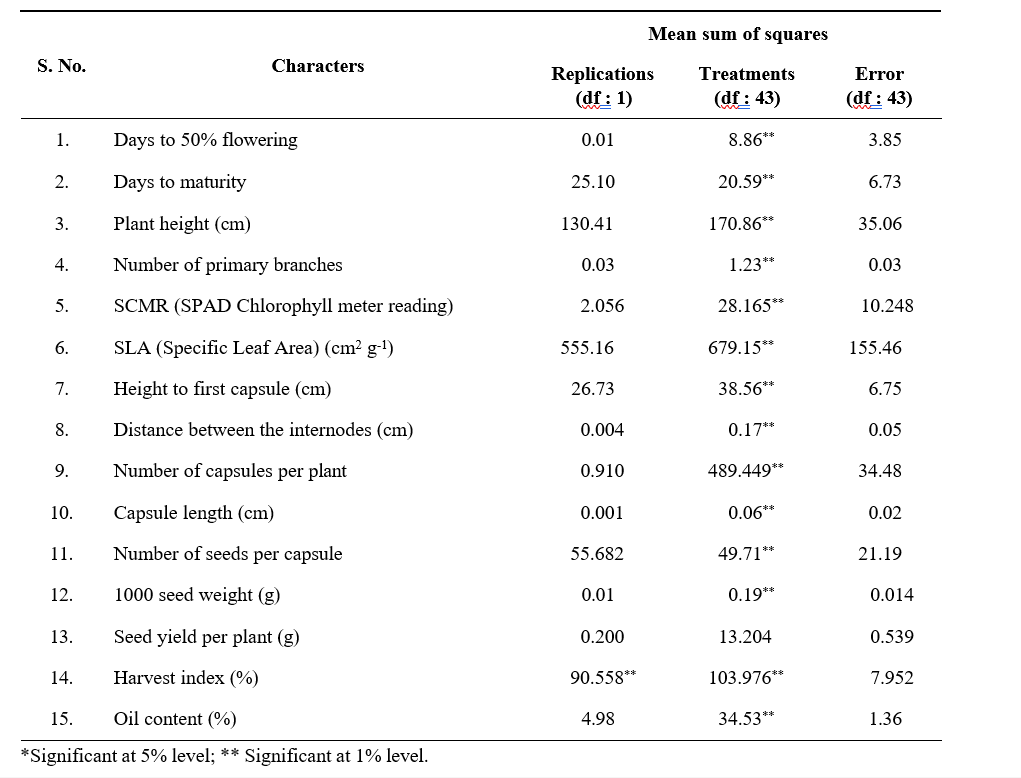
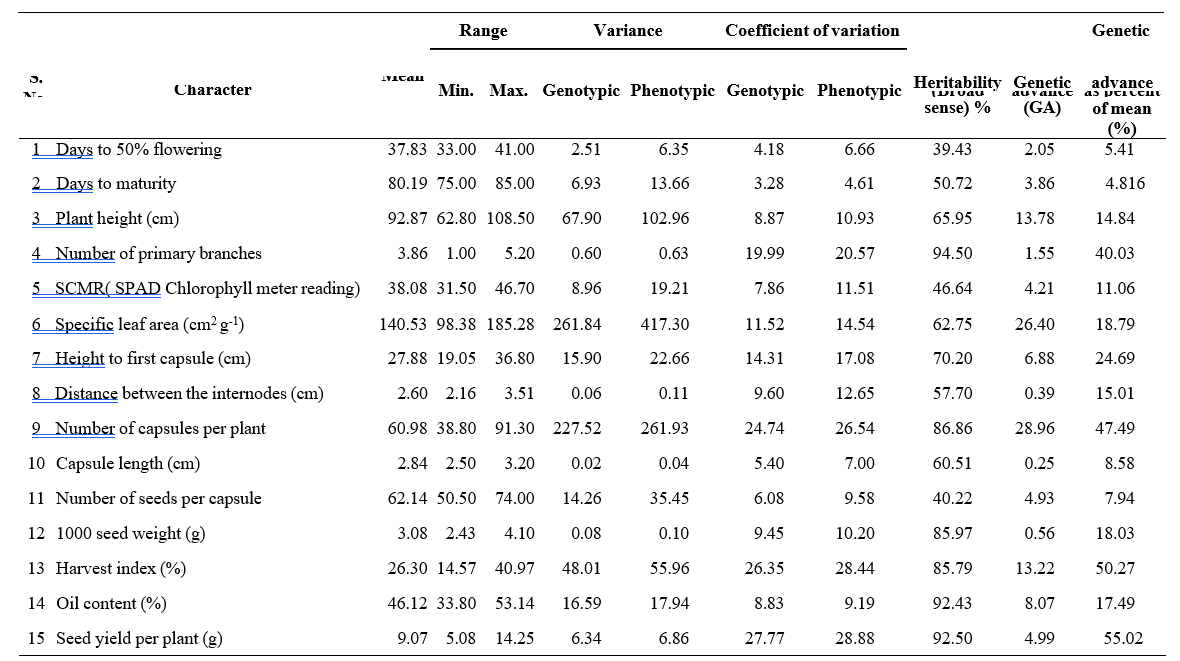
The numerical data collected on quantitative characters were statistically analyzed and analysis of variance (Table 2) showed highly significant differences among the genotypes under study for all the 15 traits indicating the presence of considerable genetic variability among the experimental material under study. The PCV was greater than GCV for all the characters suggesting that the performance of entries was influenced by the environment. The characters, seed yield per plant, harvest index and number of capsules per plant exhibited high GCV and PCV suggesting sufficient amount of variation among the advanced breeding lines and the selection would be effective for further improvement of the traits. The above results are in accordance with findings of Patil and Lokesha (2018), Kumar et al., (2022), Patel et al., (2022), and Kumari and Shah (2023). Estimates of genetic parameters for yield and yield attributing traits in forty-four accessions of sesame are given in Table. 3.
High heritability coupled with high genetic advance as per cent mean were recorded for number of primary branches (h2bs: 94.40%; GAM: 40.02%), seed yield per plant (h2bs: 92.50%; GAM: 55.02%), number of capsules per plant (h2bs: 86.86%; GAM: 47.49%), harvest index (h2bs: 85.79%; GAM: 50.27%) and height to first capsule (h2bs: 70.20%; GAM: 24.69%) indicating the preponderance of additive gene action. Therefore, phenotypic selection would be more effective for improvement of these characters. Patel et al., (2022) and Kumar et al., (2022) had reported similar results.
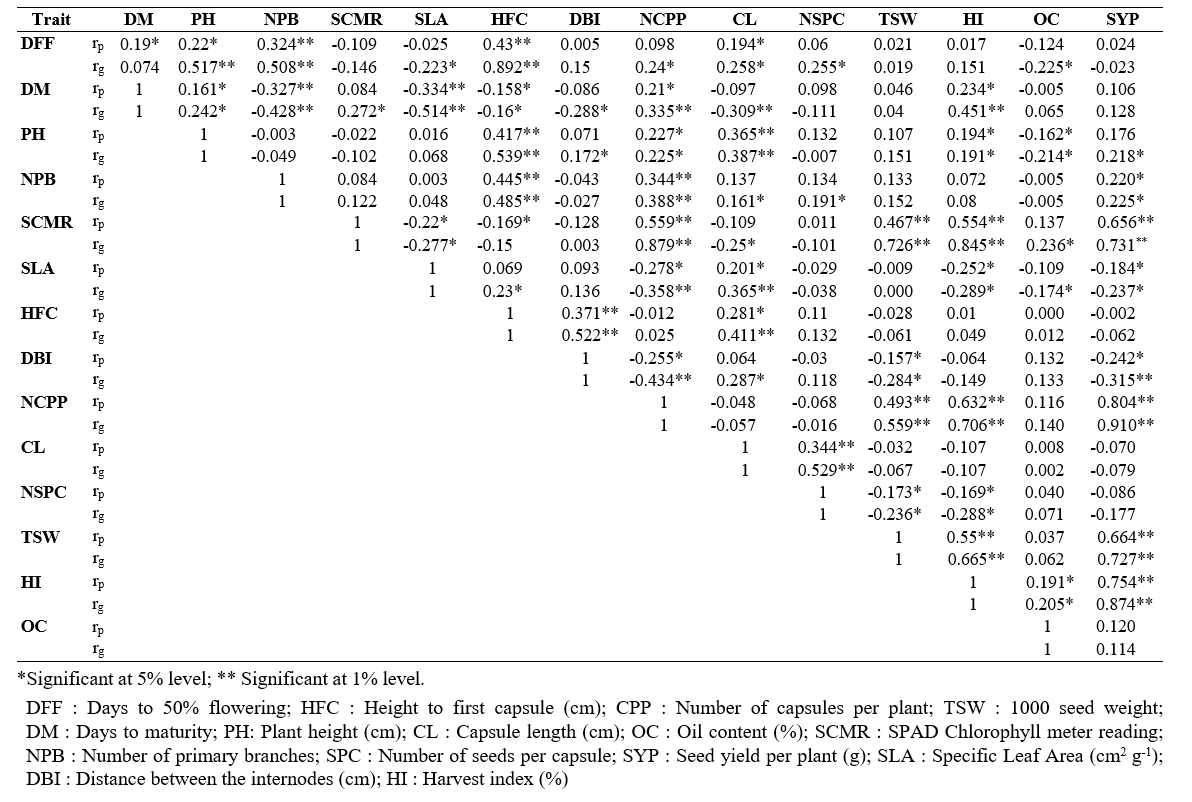
The traits number of capsules per plant (rp = 0.804**; rg = 0.910**), harvest index (rp = 0.754**; rg = 0.874**), oil content(rp = 0.31**; rg = 0.347**) and number of primary branches (rp = 0.220*; rg = 0.225*) recorded positive significant association with seed yield per plant at both phenotypic and genotypic levels indicating that these characters play an important role in selection for the improvement of seed yield per
plant (Table 4). These results were in harmony with the findings of Abate et al. (2015), Saravanan et al., (2020) and Patel et al., (2022).
In contrast distance between the internodes (rp = -0.242*; rg = -0.315**) and SLA (Specific leaf area) (rp
= -0.220*; rg = -0.277**) exhibited significant negative correlation with seed yield per plant indicating the role of these traits is important for improving seed yield per plant in sesame. Similar results were earlier reported by Hemanth et al., (2022) and Kumari and Shah (2023). Non-significant positive association of oil content (rp = 0.12; rg = 0.062) was observed with seed yield per plant. Similar results were earlier reported by Patel et al., (2022) in (Table. 4)
High heritability coupled with high genetic advance as per cent mean were recorded for number of primary branches, seed yield per plant, number of capsules per plant, harvest index and height to first capsule indicating the preponderance of additive gene action. In correlation studies, the traits viz., number of capsules per plant, harvest index, oil content and number of primary branches recorded positive significant association with seed yield per plant indicating that these characters play an important role in selection for the improvement of seed yield per plant.
Abate, M., Mekbib, F., Ayana, A and Nigussie, M. 2015. Genetic variability and association of traits in mid- altitude sesame (Sesamum indicum L.) germplasm of Ethiopia. Journal of Experimental Agriculture International. 9 (3): 1-14.
Burton, G.W and E.M. Devane 1953. Estimating heritability in all Fescue (Festuca arundanaceae) from replicated coinal material. Agronomy journal. 45: 478-481.
Burton, G.W. 1952. Quantitative inheritance in grasses. Proceedings of sixth International Grassland Congress. 1: 227-283.
Elleuch, M., Bedigian, D and Zitoun, A. 2011. Sesame (Sesamum indicum L.) seeds in food, nutrition, and health. In Nuts and seeds in health and disease prevention. Academic Press. 1029-1036.
Hemanth, S., Patil, L.C and Huilgol, S.N. 2022. Genetic correlation and path coefficient analysis studies in advanced breeding lines of sesame (Sesamum indicum L.). Journal of Farm Sciences. 35(04): 412-415.
Johnson, H.W., Robinson, H.F and Comstock, R.E. 1955a. Estimates of genetic and environmental variability in soybeans. Agronomy Journal. 47: 314-318.
Kumar, V., Sinha, S., Sinha, S., Singh, R.S. and Singh, S.N. 2022. Assessment of genetic variability, correlation and path analysis in sesame (Sesamum indicum L.). Electronic Journal of Plant Breeding. 13(1): 208-215.
Kumar, V., Sinha, S., Sinha, S., Singh, R.S. and Singh, S.N. 2022. Assessment of genetic variability, correlation and path analysis in sesame (Sesamum indicum L.). Electronic journal of plant breeding. 13(1): 208-215.
Kumari, P and Shah, P. 2023. Trait Association and path coefficient analysis for yield and yield attributing traits in Sesame (Sesamum indicum L.). Ecology, Environment and Conservation. 29: 242-249.
Patel, N.B., Acharya, R.R., Acharya, V.R., Patil, K., Patel, D.A and Parmar, D.J. 2022. Assessment of
genetic variability, correlation and path analysis in sesame (Sesamum indicum L.). In Biological Forum–An International Journal. 14(4): 496-501.
Patil, M.K and Lokesha, R. 2018. Estimation of genetic variability, heritability, genetic advance, correlations and path analysis in advanced mutant breeding lines of sesame (Sesamum indicum L.). Journal of Pharmacognosy and Natural Products. 4: 1-5.
Robinson, H.F., Comstock, R.E and Harvey, V.H.1951. Genotypic and phenotypic correlations in corn and their implications in selection. Agronomy Journal. 41: 353-359.
Saravanan, M., Kalaiyarasi, R and Viswanathan, P.L. 2020. Assessment of genetic variability, character association and path analysis in F2 population of sesame (Sesamum indicum L.). Electronic Journal of Plant Breeding. 11(2): 447-450.
Wei, P., Zhao, F., Wang, Z., Wang, Q., Chai, X., Hou, G and Meng, Q. 2022. Sesame (Sesamum indicum L.): A comprehensive review of nutritional value, phytochemical composition, health benefits, development of food, and industrial applications. Nutrients. 14(19): 4079.