
0 Views
Department of Agricultural Extension Education, S.V. Agricultural College, ANGRAU, Tirupati-517 502.
Agritourism documentation was carried out in Alluri Sitharama Raju district of Andhra Pradesh. The study was conducted in the year 2025 focusing on agritourism activities in Chintapalli and Araku Valley Mandals of the district. Among the varied agritourism activities of the farmers in the district, five agritourism farms were selected and observations were made on various agritourism activities they established. The observations revealed that large farmer had a comprehensive agritourism establishment with diverse activities of agritourism, value-added product, and proper marketing activities. The farms cultivate a diverse range of crops viz., strawberry, broccoli, carrot, green peas, chrysanthemum, and marigold as agritourism activities. Three medium farmers partially implemented the concept, offering visitor facilities and direct farm-gate sales. Whereas, one small farmer with a half-acre plot provided basic facilities to tourists and earned income from entry fees and direct product sales. The findings show a range of agritourism models, from extensive, integrated operations by large farmers to more basic, entry-level efforts of agritourism.
KEYWORDS: Agritourism activities by farmers, Alluri Sitharama Raju district.
Agritourism provides a distinctive rural gateway and offer city dwellers a look at agricultural life. By converting farm land into recreational hubs for facilitating the Agri visitors, it provides a steady source of supplemental revenue. Though participate in real agricultural tasks like ploughing fields and milking cows, picking of own fruit and vegetables visitors gain experience of agriculture activities. The concept of agritourism includes education about farming, rural living and also assisting urban dwellers in de-stressing and re-energizing to connect with nature. Visitors not only visit and get experience the agricultural activities and also purchase agri produce at farm gate. Alluri Sitharama Raju district by its initials as ASR district is in the Indian state of Andhra Pradesh, named after Alluri Sitarama Raju, a revolutionary in the Indian independence movement who hailed from the region. Agritourism in the ASR district focuses on offering visitors an opportunity to experience rural life, often in a natural and serene setting. Here are some of the popular agri-tourism activities one can find in the ASR district are: farm stays and rural immersion, culinary experiences, educational opportunities, cultural and adventure activities. In this work an attempt was made to document various activities of agritourism prevailed in Alluri Sitharama Raju district of Andhra Pradesh.
The information for case study was collected from agritourism farms in and around Araku Valley and Chintapalli areas were taken for case study purpose. A total of five agritourism farms. Observations were recorded with focused discussion with the individual agritourism farms using a common format for overall documentation of agritourism farm activities that were being carried out.
The Andhra strawberry farm was established in 2017 by Sri K. Satyanarayana, operates as a fully dedicated agritourism enterprise across 12 acres in Lambasingi village, Chintapalli mandal. The farm cultivates a diverse range of crops viz., strawberry, broccoli, carrot, green peas, chrysanthemum, and marigold. The revenue received by collecting entry fee from the visitors, collecting accommodation charges and other visiting charges from filmmakers, video makers, photographers etc. Accommodation facilities available was five air conditioned and non-air conditioner rooms. A comprehensive culinary offered include vegetarian meals, multiple non-vegetarian biryani options, locally
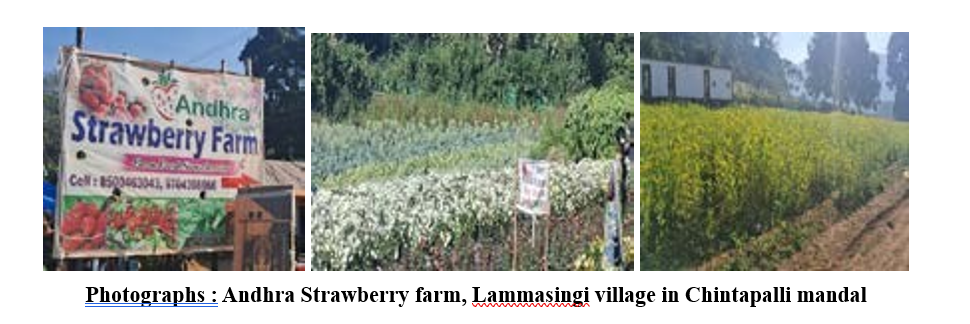
available bamboo cooked non-vegetation dishes, fish curry, and millet-based dishes. This farm also prepared various value-added products viz., strawberry milkshakes, dried strawberries, and strawberry jam to sell directly to visitors. The agritourism farm also engaged in marketing of their farm produce and products by supplying to urban retailers in Visakhapatnam, Kakinada, and Vijayawada cities The farm had been visited by over 3000 visitors annually and made total revenue of Rs. 25,00,000 annually. The farm also providing employment to rural youth and women in his village. Future strategic development plans of the farm were construction of a green houses for growing high value flower and fruit crops. (Anthony et al., 2016).
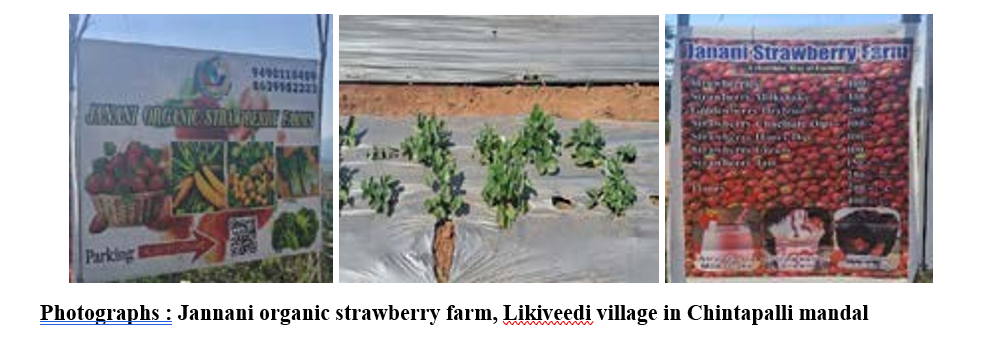
The Jannani organic strawberry farm was founded in the year 2021 by Sri K. Satyanarayana, utilizes 10 acres in Likiveedi village, Chintapalli mandal, for partial agritourism activities. Beyond cultivation of strawberry, papaya, broccoli, lettuce, watermelon, and golden berry, the farm integrates livestock (hen and sheep). No entrance fee being collected but possibility to implement as demand escalates. Visitors can have accommodation in AC and non-AC rooms which are available. It provides a variety of vegetarian and non- vegetarian dishes, alongside millet-based options. Agri-products are sold include strawberries, strawberry milkshakes, golden berry dry fruits, strawberry jam, and strawberry cream/honey/chocolate dips. Marketing channels are robust, involving direct sales to shopkeepers in Hyderabad, Vijayawada, and Visakhapatnam and supply to large retailers. Publicity is generated through word-of-mouth, YouTube, social media, and traditional press. Tourist attractions nearby include Chervulavanam view point. With an impressive turnover of 22 lakhs, Mr. K. Satyanarayana has turned farming in to a Agri business model. The future plans focus on value addition to strawberries, creating products like chocolates and sweets, and establishing an organic coffee store on-site to diversify revenue streams. (Suvarna et al.,2019).
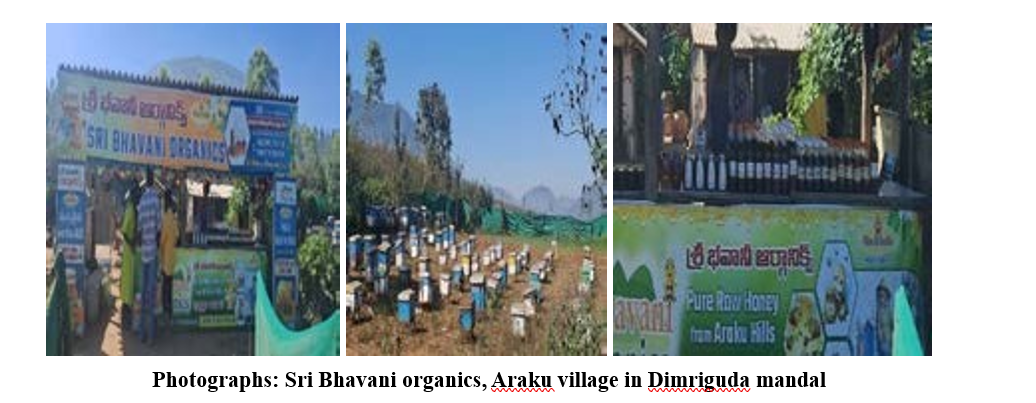
Sri Bhavani Organics, established in 2019 by Mr. Jaswanth, holding on 2 acres land in Araku village,
Dimriguda mandal, engaging in partial agritourism. The main focus of the farm is on millets, niger, sunflower, and paddy, additionally by livestock (hen, cows, ducks). The farm is located near to bus and railway stations of Araku. The farm currently not collecting entrance fees for visitors but plans to do so upon the establishment of a honey museum. Stay, food services and combo packages are not available for the tourists in the farm. Publicity on the farm is generated through conventional and digital media, in addition to direct engagement with regular customers. Nearby tourist spots include the Tribal Museum, Araku Pinery, Padmapuram Gardens, and coffee/chocolate factories. The farm specializes in selling various honey products such as Multifloral, Niger Floral, Rose Petal, and Forest Honey, along with all types of millets. Marketing is diversified, encompassing direct sales to shopkeepers in multiple cities (Vijayawada, Visakhapatnam, Rajahmundry, Hyderabad). Direct supply to major retailers and online platforms (Amazon, Flipkart). Similar to other cases mentioned above, this farm also not having membership in business associations or with A.P. Tourism and has no insurance coverage. The primary future objective is to establish a honey museum to enhance profitability. (Anita, 2014).
Amma Cottage also known as Knowledge Park, founded in 2003 by Sri Raghu Phani spann ing in 15 acres in Araku village. Over 22 years of rich experience in cultivation, the farm produces paddy, millets, niger, and banana, along with poultry and cows. The farm provides a significant accommodation for tourists with a capacity of 10 rooms and is located very near to Araku Valley bus and railway stations. The farm charges entry fees based on visitor. The food menu is covering with vegetarian full meals, various non-vegetarian biryanis, fish curry, and millet-based dishes. Distinctively, the farm offers hands-on farming experiences for an additional fee, with a penalty system for visitor-induced damages. Comprehensive training courses are provided in apiculture, sericulture, mushroom cultivation, and value addition. Marketing is achieved through direct sales to shops in major cities, direct supply to large retailers and online platforms. Widespread publicity on farm activities are given via digital and traditional media. Nearby attractions include the Tribal and Coffee Museums, Padmapuram Gardens, and Sunkarameta coffee plantation with rental vehicle services. The farm sells processed agri-products like ragi flour, ragi biscuits, millets, honey, mushroom, and silk, primarily through direct marketing to shops or export. A key differentiator in this farm is the exhibition of medicinal plantations, 5000 varieties of seeds, mushroom, apiculture, sericulture units, a fish gallery, a snake gallery, and a kids’ recreation zone, all accessible with an entry fee. Mr. Raghu phani now earn over 55 lakhs annually, hosts over 5400 visitors annually and providing employment to 12 rural youth. Despite its advanced offerings, the farm is not affiliated with any business associations or with A.P. Tourism limits the farm from coverage of insurance. The future plan of the farm involves building a function hall for the conduction of agriculture-related conferences, workshops, or training sessions to expand business operations. (Laxman et al.,2024).
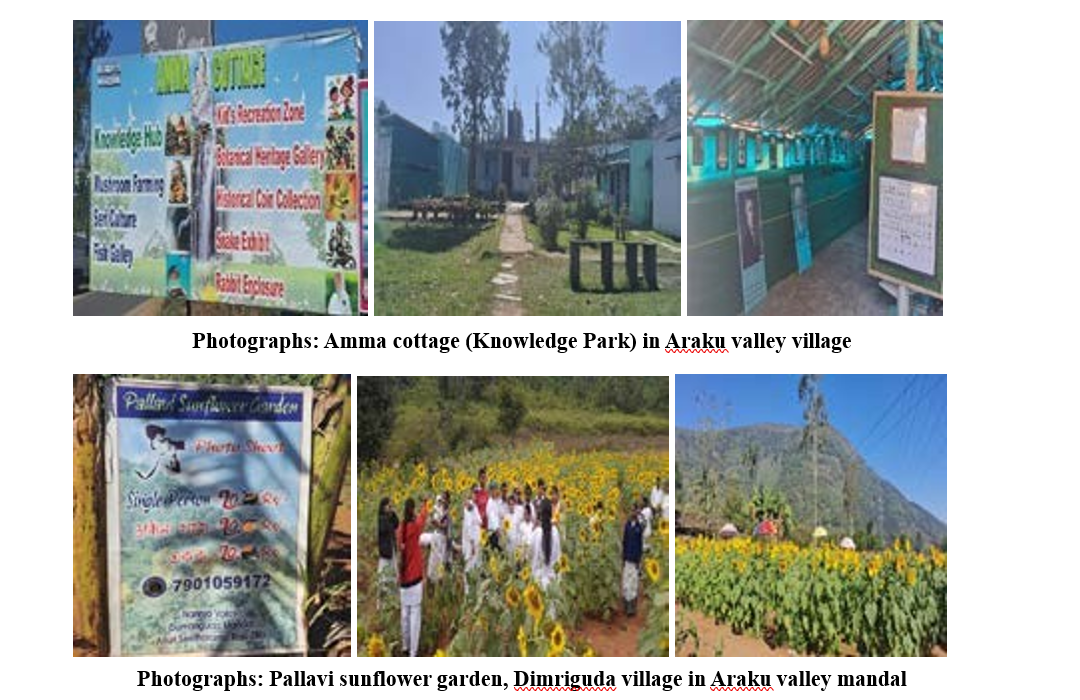
Sri P. Ramu established Pallavi Sunflower Garden, in 2019 which represents an early-stage agritourism initiative in half-acre land holding in Dimriguda village, Alluri Sitharama Raju district. The primary crops cultivated by the farm includes sunflower, maize, groundnut, radish, beans, millets, mirchi, and brinjal, supported by cows, goats, and poultry farming. The farm is situated near Araku Valley bus and railway stations and charges entry fees for various visitor categories (general public, foreign tourists, filmmakers, students, pre-wedding shoots) to explore the premises. However, it currently does not offer accommodation, food, hands- on experiences, training, or combo packages. The farm sells minimal quantities of raw agricultural produce such as maize cobs, groundnuts, millets, mirchi, radishes, and beans directly to visitors. Marketing is primarily conducted through direct farm gate sales and participation in the Araku Rural Haat (weekly market), supplemented by word-of-mouth, YouTube, social media, and traditional press. Unique to this farm is the arrangement of umbrellas and photogenic spots within the field to enhance visitor attraction. Nearby tourist spots include Padmapuram Gardens, Sunkarameta coffee plantation, and the Tribal Museum. The farm cannot facilitate the coverage of insurance because of not having membership in business associations or A.P. Tourism. Farming of strawberry to increase profitability is the future plan of the farm. (Rohit et al., 2020).
This study alternates that agritourism in Alluri Sitharama Raju district spans a spectrum from integrated, large-scale ventures offering accommodation, hands- on experiences, and robust marketing, to small-scale projects focusing on basic tourism and direct sales. While these initiatives successfully combine agriculture and tourism to generate additional income and employment. Systematic documentation highlights the diversity and evolving nature of agritourism models in the region, underscoring both the opportunities and the need for capacity-building to realize its full potential.
Anitha, S. 2014. Agrotourism – Acase study. International Journal of Innovative Research and Practices. 2(2): 28-33.
Anthony, Y., John, O., Jarvetta, B and Ralph, O. 2016. Case studies of agritourism among small farmers in North Carolina. Proceedings of Southern Agricultural Economics Association’s Annual Meeting, San Antonio, Texas. pp. 1-16.
Laxman, M., Venkatesan, P and Balakrishnan, M. 2024. Agri tourism – An innovation to earn an extra income from farm activities – A case of tourism centers in Maharashtra, India. AgriGate – An International Multidisciplinary e-Magazine. 4(7): 1-6.
Rohit, B and Venkata Rao, Y. 2020. Innovative agritourism models: Cases from Pune region. Journal of Small Business and Rural Management. 3(1): 64-75.
Suvarna, S and Randhave, M. 2019. Argo-tourism: A sustainable tourism development in Maharashtra – A case study of village in agrotourism (Wardha). International Journal of Management Research. 7(6): 45-56.