

0 Views
Department of Agronomy, S.V. Agricultural College, ANGRAU, Tirupati-517 502.
A field experiment was conducted during rabi, 2024-25 at Dryland farm, S.V. Agricultural College, Tirupati campus of Acharya N. G. Ranga Agricultural University, Andhra Pradesh, India to study the effect of different levels of fertilizers and biofertilizers on productivity of finger millet. The experiment was laid out in randomized block design and replicated thrice. Among the different nutrient management practices tested, Application of 100% RDF + seed treatment with liquid biofertilizers
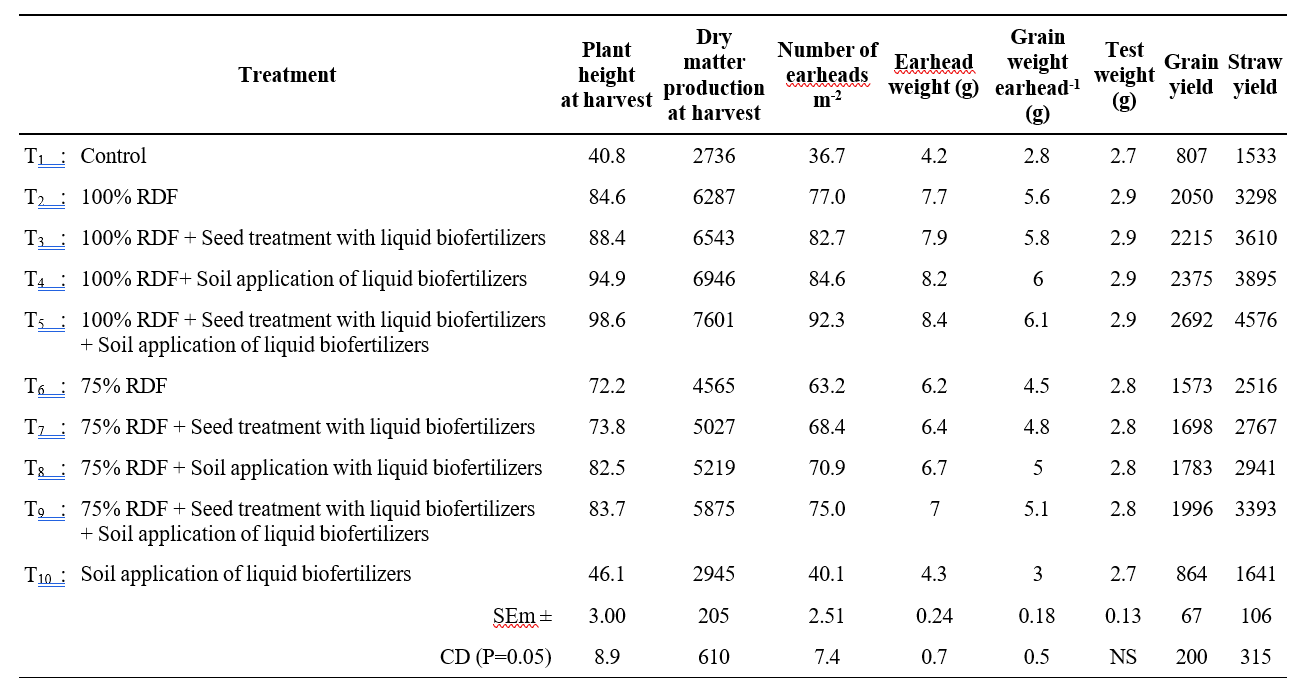
+ soil application of liquid biofertilizers (T5) resulted in higher plant height, dry matter production, number of earheads m-2, earhead weight (g), grain weight earhead-1 (g) and test weight (g), grain and straw yield (kg ha-1) which was however comparable with application of 100% RDF + soil application of liquid biofertilizers (T4). While they were found at their lowest with the absolute control (T1) which was comparable with soil application of liquid biofertilizers (T10).
KEYWORDS: Finger millet, liquid biofertilizer, seed treatment and soil application.
Finger millet (Eleusine coracana L. Gaertn.), a staple crop in semi-arid and tropical regions, plays a significant role in food security, nutrition, and sustainable agriculture. Apart from its adaptability, finger millet is nutritionally superior to many other cereals, boasting high fiber (11.5 %), proteins (7.6 %), calcium (0.33%), iron (0.039%) and essential amino acids. In addition to these, lower glycemic index makes it highly suitable for diabetic patients. It has 10-fold higher calcium than brown rice, wheat and maize (Thapliyal and Singh, 2015.). Despite these advantages, maximizing its productivity remains a challenge, often requiring external nutrient supplementation. Traditional farming practices heavily rely on chemical fertilizers to improve yield. These factors compromise soil health, ultimately affects crop performance and sustainability. As the global focus shifts towards eco-friendly agricultural solutions, biofertilizers emerged as promising alternatives that foster soil health while ensuring optimal crop yield. Biofertilizers are substances that contain either latent or active strains of soil microorganisms, such as bacteria, algae or fungi, which improve the availability and uptake of nutrients by plants, leading to improved crop yields upto 10- 40%. (Bhardwaj et al., 2014). Liquid biofertilizers, in contrast to traditional carrier-based formulations, offer several advantages like higher cell counts, longer shelf life, ease of application, better storage and transport. They enhance nutrient availability, promote microbial activity, and improve soil biological properties, leading to better nutrient uptake, increased yield, and enhanced soil fertility. Seed treatment involves coating seeds with biofertilizer before sowing, which ensures early root colonization, better seedling vigor, and protection against soil-borne pathogens. Soil application, on the other hand, enriches the rhizosphere directly, enhancing nutrient mobilization and microbial activity around the root zone during critical stages of crop growth. Understanding the most effective method of application could significantly improve crop productivity, nutrient use efficiency and soil sustainability. However, limited studies were carried out on the effect of liquid biofertilizers with chemical fertilizers in finger millet. Hence, the present experiment was conducted to study the effect of different levels of fertilizers and liquid biofertilizers on productivity of finger millet.
The field experiment was conducted at Dryland farm, S.V. Agricultural College, Tirupati campus of Acharya N.G. Ranga Agricultural University which is geographically situated at 13.5°N latitude and 79.5°E longitude, with an altitude of 182.9 m above the mean sea level, in the Southern Agro-Climatic Zone of Andhra Pradesh. The soil of experimental field was sandy loam in texture, neutral in soil reaction, low in organic carbon (0.4%) and available nitrogen (207 kg ha-1), medium in available phosphorus (24.3 kg ha-1) and available potassium (213 kg ha-1). The experiment was laid out in randomized block design and replicated thrice. The treatments consisted of ten treatments absolute control (T1), application of 100% RDF (T2), application of 100% RDF + seed treatment with liquid biofertilizers (T3), application of 100% RDF + soil application of liquid biofertilizers (T4), application of 100% RDF + seed treatment with liquid biofertilizers + soil application of liquid biofertilizers (T5), application of 75% RDF (T6), application of 75% RDF + seed treatment with liquid biofertilizers (T7), application of 75% RDF + soil application of liquid biofertilizers (T8), application of 75% RDF + seed treatment with liquid biofertilizers + soil application of liquid biofertilizers (T9) and soil application of liquid biofertilizers (T10). A total rainfall of 424 mm was received in 17 rainy days during the crop growing period. The recommended dose of fertilizers in finger millet is 60-30-20 kg N, P2O5, K2O ha-1. The fertilizers were applied as per the treatments seed treatment with liquid biofertilizers (Azospirillum, PSB and KSB) was done by mixing 10 ml of each bioinoculants to 1 kg of seed and dried for 10-15 min under shade before sowing. For soil application of liquid biofertilizers (Azospirillum, PSB and KSB), 1.25 l ha-1 of each microbial inoculant was mixed in 500 kg of well decomposed FYM and applied as basal dose. The variety ‘Vakula ‘was transplanted with the spacing 22.5 cm x 10 cm. All the other practices were adopted as per the recommendations of ANGRAU. The data were subjected to analysis of variance procedures as outlined for randomized block design as suggested by Panse and Sukhatme (1985). Statistically significance was tested by F-value at 5 % level of probability and critical difference was worked out where ever the effect was significant.
Application of 100% RDF + seed treatment with liquid biofertilizers + soil application of liquid biofertilizers (T5) resulted in higher plant stature at harvest which was however comparable with application of 100% RDF + soil application of liquid biofertilizers (T4), whereas for the dry matter production, it differed significantly. The lowest plant stature and dry matter production were recorded with the soil application of liquid biofertilizers (T10) and absolute control (T1) without any significant disparity between them in the order of descent (Table 1). Integration of liquid biofertilizers with 100% RDF resulted in more balanced nutrient profile. Besides these, application of liquid biofertilizers also resulted in production of plant growth-promoting hormones such as auxins, gibberellins, and cytokinin’s that stimulate cell division and elongation. As a result, plant grows taller and exhibit more vigorous above ground growth. Thus, administration of liquid biofertilizers along with 100% RDF resulted in enhanced photosynthetic efficiency, profuse tillering and overall plant growth, ultimately leading to greater dry matter production, as evidenced by the findings of Yadav et al., (2025) and Sukanya et al., (2023).
The treatment comprising application of 100% RDF + seed treatment with liquid biofertilizers + soil application of liquid biofertilizers (T5) resulted in higher earhead weight, grain weight earhead-1 which was however comparable with application of 100% RDF + soil application of liquid biofertilizers (T4), whereas for the number of earheads m-2, they differed significantly. Soil application of liquid biofertilizers (T10) and absolute control (T1) were comparable with one another in registering the lowest number of earheads m-2 over the rest of the treatments. This was attributed to the readily available nutrients during critical growth stages with integrated application of chemical fertilizers and biofertilizers, aided in better root growth, development, enhanced uptake and translocation of nutrients. Consequently, the improved nutrient status and biological activity resulted in more efficient photo assimilates partitioning towards sink from source. The present results were in accordance with the findings of Kejiya et al., (2019), Deepti et al., (2022) and Ahiwale et al., (2011).
Test weight of finger millet was not significantly influenced by different levels of fertilizers and liquid biofertilizers. Yet with no marked differences, higher test weight of finger millet was recorded with the application of 100% RDF + seed treatment with liquid biofertilizers + soil application of liquid biofertilizers (T5), while the minimum test weight was registered with absolute control (T1). These findings were in conformity with the findings of
Gangothri et al., (2023) and Senthamil et al., (2021).
The highest grain and straw yield of finger millet were obtained with the application of 100% RDF + seed treatment + soil application of liquid biofertilizers (T5) which was significantly superior over the rest of the treatments. This might be due to the combination of fertilizers and biofertilizers which together optimized nutrient availability and plant uptake throughout the growing season, led to improved root development, increased nutrient use efficiency. Additionally, the dual application of biofertilizers (seed + soil) maximized their benefits, as microbes worked in tandem with chemical fertilizers to reduce nutrient losses and promote balanced plant nutrition which resulted in the increased photosynthetic rate, enhanced biomass production coupled with better partitioning of photosynthates from source to sink, there by enhanced morphological characters i.e., plant height, leaf area and dry matter production that in turn reflected in higher straw yield of finger millet. Ultimately culminating in higher grain and straw yield of finger millet. These findings were in line with the findings of Sukanya et al., (2023) and Deepti et al,., (2022).
Absolute control (T1) recorded significantly lower grain yield which was at par with soil application of liquid biofertilizers (T10). From this it was proved that chemical fertilizers could not be replaced by biofertilizers alone and they should be integrated with any organic matter or chemical fertilizers to function effectively.
Application of 100% RDF + Seed treatment with liquid biofertilizers + Soil application of liquid biofertilizers in finger millet significantly increased the crop growth performance, yield attributes and yield over the rest of the treatments tried in sandy loam soils of Southern Agro- climatic zone of Andhra Pradesh.
Ahiwale, P.H., Chavan, L.S., Jagtap, D.N., Mahadkar, U. V and Gawade, M.B. 2011. Effect of establishment methods and nutrient management on yield attributes and yield of finger millet (Eleusine coracana L.). Crop Research. 45(3): 141-145.
Bhardwaj, D., Ansari, M.W., Sahoo, R.K and Tuteja, 2014. Biofertilizers function as key player in sustainable agriculture by improving soil fertility, plant tolerance and crop productivity. Microbial Cell Factories. 13: 1-10.
Deepti, C.H., Sukanya, T.S., Latha, H.S., Umashankar, N., Anand, M.R and Mamatha, B. 2022. Response of finger millet (Eleusine coracana L.) to liquid biofertilizer consortium and its methods of application. Mysore Journal of Agricultural Sciences. 6(1): 65-71.
Gangothri, K., Umesha, C and Venkatesh, C. 2023. Effect of different levels of nitrogen and seed treatment on growth and yield of finger millet (Eleusine coracana L.). International Journal of Environment and Climate Change. 13(10): 1474-1481.
Kejiya, P., Vajantha, B., Naidu, M.V.S and Nagavani, A.V. 2019. Effect of phosphatic fertilizer and biofertilizers on yield and quality of finger millet (Eleusine coracana L.). International Journal of Current Microbiology and Applied Sciences. 8(7): 846-852.
Panse, V.G and Sukhatme, P.V. 1985. Statistical Methods for Agricultural Workers. ICAR, New Delhi. 187-202.
Senthamil, E., Kalaiyarasan, C., Suseendran, K., Muruganandam, C and Jawahar, S. 2021. Effect of VAM, sulphur and boron on growth and yield of ragi (Eleusine coracana L. Gaertn.). Research Journal of Agricultural Sciences. 12(2): 689–692.
Sukanya, T.S., Anand, M.R and Chaithra, C. 2023. Finger millet system productivity as influenced by liquid biofertilizer consortium. Indian Journal of Ecology. 50(5): 1647-1652.
Thapliyal, V and Singh, K. 2015. Finger Millet: Potential millet for food security and power house of nutrients. International Journal of Research in Agriculture and Forestry. 2(2): 22-33.
Yadav, B., Bharati, V., Yadav, T. K., Kumar, D., Dwivedi, K., Borah, A and Kumar, A. 2025.The effect of liquid biofertilizer practices on the growth and yield of finger millet. International Journal of Research in Agronomy. 8(3): 132-136.