

0 Views
Department of Entomology, S.V. Agricultural College, ANGRAU, Tirupati-517 502.
The present study evaluated the bio efficacy of Azadirachtin (10,000 ppm), silica and nano silica formulations against the pulse beetle, Callosobruchus maculatus (Fabricius), a key pest of stored pulses. Among the treatments, Azadirachtin (10,000 ppm) demonstrated the highest efficacy, recording 100% mortality by the 7th day, with the lowest LC₅₀ (0.16%) and LT₅₀ (1.39 days), indicating rapid and potent action. Silica and nano silica exhibited moderate but delayed mortality, requiring higher concentrations and longer exposure. Spinosad, used as a chemical check, also showed significant toxicity. The results suggest that Azadirachtin is a promising eco-friendly alternative for the sustainable management of C. maculatus in storage systems.
KEYWORDS: Callosobruchus maculatus, Azadirachtin, Nano silica, Silica, Spinosad, Stored product pests, Biopesticides.
Pulses are nutrient rich edible seeds of leguminous crops, valued for their high protein, fibre and essential nutrients, making them a key part of the vegetarian diet of Indians. India leads the world in pulses production, contributing 38% to the global area and 28% to total production, with an estimated 24.25 million metric tons produced in 2024 (FAOSTAT, 2023–24). Andhra Pradesh ranks among the top 10 states, producing 3.33 lakh tons in the year 2024 (www. Statista. com). Despite their importance, pulses suffer significant losses due to insect pests, both in the field and during storage. Among these, the pulse beetle, Callosobruchus spp. is the most destructive storage pest, infesting a wide range of pulses. Infestation starts in the field and continues till post- harvest. The hidden infestation of pulse beetle causes severe quantitative and qualitative losses, making its management critical for safe storage of pulses for long duration.
The increasing development of insecticide resistance among storage pests, along with the presence of harmful residues in food and the environment, has significantly restricted the reliance on chemical insecticides and fumigants. As a result, there is a growing need to explore natural pesticide alternatives that are easily accessible, eco-friendly, and safe for non-target organisms, without compromising the market value of stored grains.
Essential oils derived from various plant species exhibit ovicidal, larvicidal and repellent activities against a wide range of insect pests and are considered eco-friendly alternatives to conventional pesticides (Isman, 2000; Cetin et al., 2004). Neem-based products have shown potential as natural grain protectants due to their ovicidal, larvicidal, and repellent actions, offering a sustainable approach for managing storage pests under tropical conditions (Saxena et al., 2018). Silica and Nano silica based formulations are emerging as effective bio pesticides for stored grain pest management. They are p hysiosorbed by the insect’s cuticular lipids, which results in considerable injury and the insect’s death (Barik et al., 2008). According to Saw et al., 2023, Silica nano particles act as an ecofriendly biopesticide for killing the target insect pest and improve plant resistance to insect pests.
Hence the present study was carried out to evaluate the efficacy of bio pesticides like Neem oil, Silica, Nano silica along with chemical check Spinosad against pulse beetle, C. maculatus.
The present investigation was carried out at Department of Entomology, S.V. Agricultural College, Tirupati, Acharya N.G. Ranga Agricultural university, Andhra Pradesh, India during 2024-25.
Commercial neem formulation, Neem azal (10,000 ppm) and Spinosad (Tracer 45% SC) were purchased from local market in Tirupati were used for bio assay studies.
Silica and nano silica formulations were synthesized at Nano technology lab, Institute of Frontier Technology, Regional Agricultural Research station, Tirupati.
The pulse beetle adults collected from pulse storage godown of Regional Agricultural Research Station, Tirupati, Andhra Pradesh were maintained at laboratory, Department of Entomology, S.V. Agricultural College, Tirupati under ambient conditions at 25+ 2°C and 75% RH. For mass multiplication, about ten pairs of adult pulse beetles were released into plastic containers containing 500-gram green gram seed and the mouth of the container was covered with muslin cloth and secured with a rubber band. The jars were kept undisturbed till the emergence of F1 adults. The pulse beetles were mass multiplied and the freshly emerged beetles were used for the bioassay studies.
Nano silica particles were synthesised using Sol- gel method (Bokov et al., 2021). Tetraethyl ortho silicate (TEOS) and CH3COOH (acetic acid glacial) were mixed using a magnetic stirrer for 30 min and rinsed with double-deionised water (DI-water) and allowed to dry in air at room temperature. Then the mixture was made into fine powder and decomposed in air by keeping it in a preheated muffle furnace for 90 min at 600°C.
Dynamic Light Scattering Spectroscopy (DLS for Size and Zeta Potential Measurements of nano particles). Dynamic light scattering (DLS) was performed using particle sizing system, Horiba Nanoparticle analyzer at a wavelength of 633 nm from a 4.0 mW, solid-state He-Ne laser at a scattering angle of 170°. Intensity average, volume average and number average diameters were calculated from the auto correlation function using Malvern’s Zeta sizer Nano 4.2 software utilizing a version of the CONTIN algorithm.
The efficacy of bio pesticides were evaluated against pulse beetle adults using diet incorporation method. Each biopesticide was tested at 5 different concentrations and the adult mortality percentage was calculated at different time intervals at 1, 3, 5, 7 and 15 days after treatment. Different concentrations of Azadirachtin (10,000 ppm) (0.1, 0.25, 0.5, 0.6 and 1.0 per cent) were prepared using distilled water as a solvent by serial dilution method. Silica and nano silica were also taken at five different concentrations (1.5, 2, 5, 7.5 and 10 g kg-1). Spinosad was taken at 0.003, 0.005. 0.01, 0.03 and 0.05 per cent. 20 grams of green gram seed was thoroughly mixed with required concentrations of bio pesticides and was kept in plastic containers to achieve equal distribution and the containers were shaken manually for 5 minutes and allowed to shade dry for 24 hours. Freshly emerged Twenty pulse beetle adults were released into each plastic container and the experiment was replicated four times. The containers were closed with muslin cloth for sufficient ventilation and kept under ambient conditions in the laboratory at at 25+ 2°C and 75% RH. The pulse beetle adult mortality counts were taken after 1, 3, 5, 7 and 15 days after exposure.
Based on adult pulse beetle mortality, LC50, LC90 and LT50 values were calculated using probit analysis using the SPSS statistical package for determining their effectiveness against C. maculatus.
Dynamic Light Scattering technique used to measure the hydrodynamic diameter (HDD) of the particles, showed that nano silica particles have mean size of 69.4 nm and the zeta potential was also measured and recorded as -23.4 mV for nano silica (Fig 1).
Among different biopesticides, Azadirachtin (10,000 ppm) demonstrated the highest effectiveness, causing 90 % mortality at 0.6 % concentration by 5th day and 100 % by 7th day at 0.6% and 1.0% concentrations and 100% mortality in all the treatments by 15th day. This was further supported by its lowest LC₅₀ value (0.16%) and shortest LT₅₀ (1.39 days), indicating both high potency and rapid action.
Silica showed a moderate and delayed response, with low initial mortality at 1st day (5%) at lower concentrations but notable increase was observed by 5th and 7th day, especially at higher concentrations (7.5–10 g/ kg), where mortality reached 100%. LC₅₀ value of 2.19 g/ kg, and LT₅₀ of 2.58 days of silica indicating that higher doses and longer exposure are required for effective control. The likely mode of action is through abrasion and desiccation, leading to slow but cumulative mortality.
Nano Silica exhibited the slowest action among the three treatments. Mortality remained low to moderate until 5th day (32.5% -87.5%) and on 7th day mortality
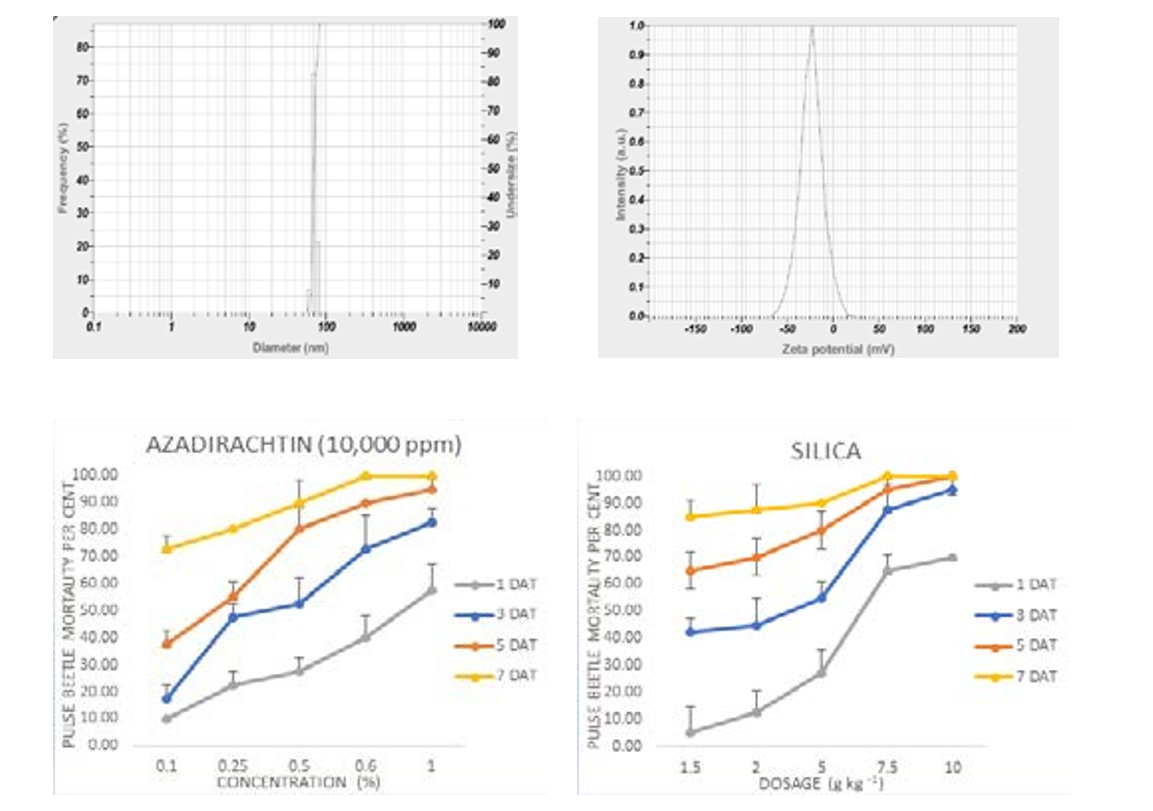
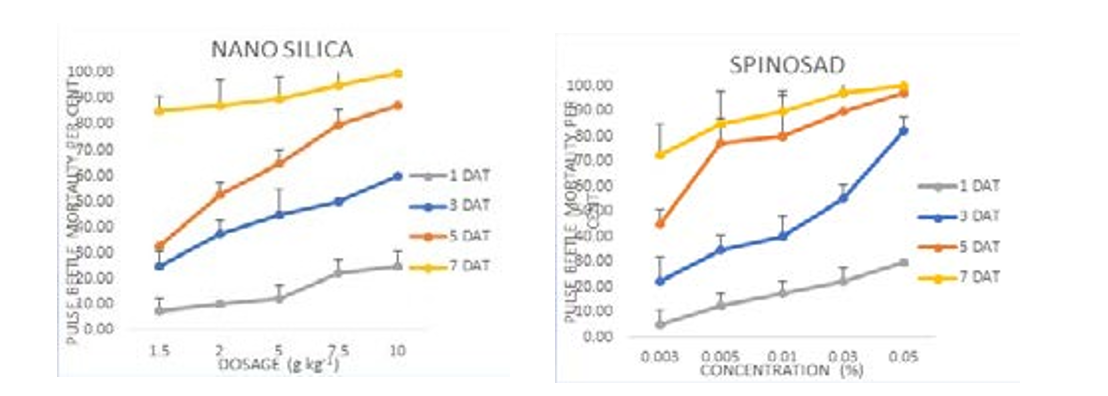
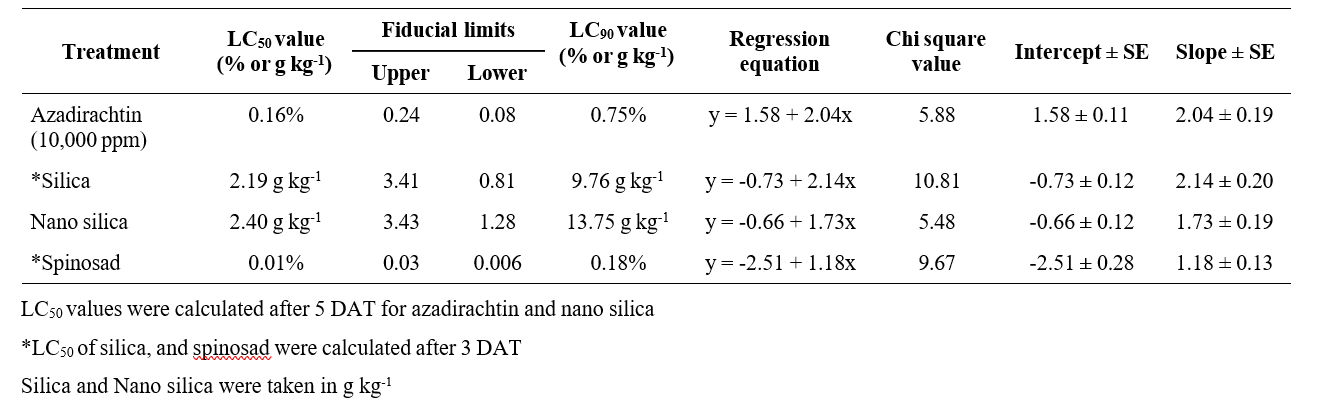
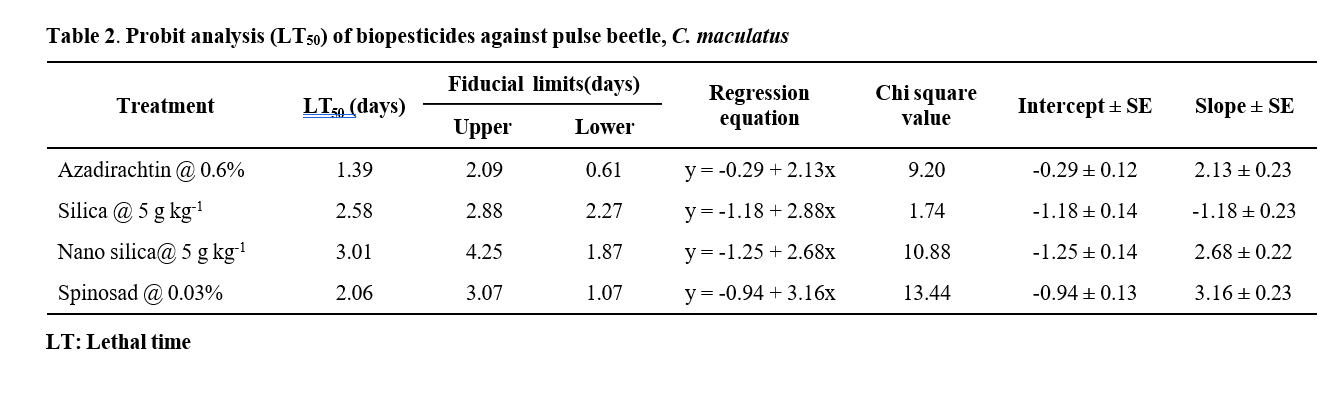
reached around 90-100% at higher concentrations.100 % mortality was observed in all the treatments by the 15th day. The LC₅₀ was 2.40 g/kg, and LT₅₀ was 3.01 days, reflecting lower toxicity and slow releasing effect.
The chemical check Spinosad was also found effective against pulse beetles with 90% mortality was seen after five days of treatment at 0.03% and 100% at 0.05%. LC₅₀ was 0.01% and LT₅₀ was 2.06 days.
These findings are line with Rajasri and Rao (2012) who reported that commercially available neem formulations viz., Econeem plus®, Neemindia ® and Neemazal ® found effective control of pulse beetle, C. chinensis in stored Bengal gram.
The present findings are in line with Rajasri et al., (2014) studied efficacy of neem formulations on pulse beetle and reported that all the commercial neem formulations viz., Econeem plus®, Neemindia ® and Neemazal ® were effective against C. chinensis in stored black gram up to 15 months of storage.
In similar lines, Arora et al., (2018) evaluated toxicity viz., neem and clove oil against adults of Tribolium castaneum at different concentrations viz., 10, 15, 20 and 25% of neem oil and clove oil. The clove oil resulted in 100% mortality at the higher concentration (25%) after 48 hours of treatment. The neem oil revealed only 86.9 per cent mortality at higher dose (25%) after a period of 48 hours after treatment.
Mondal et al., (2018) tested the efficacy of Spinosad against pulse beetle, C. chinensis using diet incorporation method and contact toxicity method. The LC50 value is found to be around 95 ppm after 72 hours which is almost same as the findings of the current study.
Rani et al., (2022) studied the efficacy of essential oils like neem-azal, clove oil and acorus oil different concentrations against red flour beetle, Tribolium castaneum. Neem-azal at 2.0 per cent was found to be effective with LC50 value of 1.11 per cent and LT50 value of 2.4 days followed by acorus oil 15.0 per cent with LC50 value of 16.43 and LT50 value of 4.30 days against Tribolium larvae.
Based on LC50, LC90 and LT50, among the different treatments tested, Azadirachtin (10,000 ppm) found be very effective against pulse beetle. The safer and ecofriendly bio pesticides are recommended for the control of pulse beetle and reduce the risk of chemical residues in stored grains, promoting sustainable management.
I am highly thankful to Acharya N.G. Ranga Agricultural University, Guntur and Indian Council of Agricultural Research, New Delhi for all the facilities extended during the period of my post-graduation programme and for the financial assistance provided during my post-graduation.
Arora, M.S., Priya, K.C and Gunwati, V.A. 2018. Effect of clove oil (Syzygium aromaticum) and neem oil (Azadirachta indica) on Tribolium castaneum (Herbst) (Coleoptera: Tenebrionidae). Journal of Emerging Technologies and Innovative Research. 5(12).
Barik, T.K., Sahu, B and Swain, V. 2008. Nano silica from medicine to pest control. Parasitology Research. 103: 253-258.
Bokov, D., Jalil, A.T., Chupradit, S., Suksatan, W., Ansari, M.J., Shewael, I.H., Gabdrakhman, H. V and Kianfar, E. 2021. Nanomaterial by sol- gel method: synthesis and application. Advances in Materials Science and Engineering. 2021(1): 5102014.
Cetin, H., Erler, F and Yanikoglu, A. 2004. Larvicidal activity of a botanical natural product, AkseBio2, against Culex pipiens. Fitoterapia. 75(7-8): 724-728.
Isman, M.B. 2000. Plant essential oils for pest and disease management. Crop Protection. 19(8-10): 603-608.
Mondal, P., Uddin, M.M. and Howlader, M.T.H. 2018. Determination of toxicity of spinosad against the pulse beetle, Callosobruchus chinensis L. Biotoxicity of spinosad against the pulse beetle. Journal of the Bangladesh Agricultural University. 16(3): 411-416.
Rajasri, M. and Rao, P.S. 2012. Neem formulations– safer seed protectants against pulse beetle, Callosobruchus chinensis for long term storage of Bengal gram. Indian Journal of Entomology.18(1): 157-163.
Rajasri, M., Sudharani, M and Rao, P.S. 2014. An ecofriendly management of pulse beetle, Callosobruchus chinensis using neem formulations in black gram. International Journal of Science and Research. 3(11): 2944-2948.
Rani, S., Rajasri, M., Panduranga, G and Prasad, T. Ecofriendly biopesticides for the management of red flour beetle, Tribolium castaneum (Herbst) in stored rice. Andhra Pradesh Journal of Agricultural Sciences. 8(2): 105-109.
Saw, G., Nagdev, P., Jeer, M and Murali-Baskaran, R.K. 2023. Silica nanoparticles mediated insect pest management. Pesticide Biochemistry and Physiology. 194: 105524.
Saxena, R.C., Jilani, G and Kareem, A.A., 2018. Effects of neem on stored grain insects. Focus on Phytochemical Pesticides. 97-112.