

0 Views
Department of Entomology, S.V. Agricultural College, ANGRAU, Tirupati-517 502.
A sunflower hybrid (KBSH-44) was sown on second fortnight of October at Regional Agricultural Research Station, Nandyal, Andhra pradesh during rabi, 2024-25. The seasonal incidence of sucking pests viz., leafhopper (Amrasca biguttula biguttula), whitefly (Bemisia tabaci), thrips (Thrips palmi) and natural enemies were observed in sunflower hybrid KBSH- 44 during rabi, 2024-25. The incidence of sucking pests viz., leafhopper, whitefly and thrips was first appeared 15 days after germination. Peak incidence of sucking pests was recorded in 51st and 2nd standard week. The correlation studies on leafhopper, whitefly and thrips showed negative correlation with maximum temperature, minimum temperature, sunshine hours and wind velocity, but positive correlation with rainfall, morning and evening relative humidity. Natural enemies like spiders and ladybird beetles positively correlated with wind velocity, morning and evening humidity, while negatively correlated with maximum temperature, minimum temperature, rainfall and sunshine hours.
KEYWORDS: Sunflower, Sucking pests, Natural enemies, Weather parameters.
Sunflower (Helianthus annuus L.) popularly known as “surajmukhi” family Asteraceae. It is native to southern parts of USA and Mexico (Heiser, 1951). Sunflower is one of the important edible oilseed crop grown in the world after soybean and groundnut. Sunflower oil is a rich source of linoleic acid (64 per cent) which helps in washing out cholesterol deposition in the coronary arteries of heart and thus good for heart patients. In India, during 2023-24, sunflower was cultivated on an area of 1.51 lakh ha with 1.72 lakh tonnes of production and 1144 kg ha-1 of productivity (indiastatagri 2024). In Andhra Pradesh, sunflower was cultivated on an area 0.04 lakh ha with 0.038 lakh tonnes of production and 886 kg ha-1 of productivity in 2023- 24 (indiastatagri 2024). The principal states in India that cultivate sunflower include Karnataka, Andhra Pradesh, Maharashtra, Orissa, Bihar, Haryana, Punjab, Tamil Nadu and West Bengal. Among these states, Karnataka ranks first and Andhra Pradesh ranked eighth in terms of sunflower production and area. In Andhra Pradesh, Kurnool district is one of the prominent sunflower growing area, where the crop is largely cultivated under rainfed conditions during late kharif and as irrigated crop during rabi and summer seasons. Insect pests infestation is one of the major constraint for sunflower production. In India more than 50 insect species have been recorded to damage the crop at different growth stages and nine are major pests. Meteorological variables play a vital role in multiplication and distribution of insect pests, which directly influence the abundance of natural enemies (Zafar et al., 2013). To formulate an effective, economic and sustainable pest management strategy for a specific agro- ecosystem, complete knowledge on abundance and distribution of pest in relation to weather factors is a basic requirement (Patel and Shekh, 2006). In India, the major sucking insect pests include leafhopper (Amrasca biguttula biguttula Ishida) and whitefly, (Bemisia tabaci) are of major economic importance (Basappa, 2004). Many thrips species that are associated with crop are also acting as vectors for transmitting sunflower necrosis virus and other viral diseases. Sucking insect-pest of sunflower cause 44 per cent of yield losses (Kakakhel et al., 2000). The incidence of sucking pest on sunflower crop varied due to several factors like planting time, variety and most important abiotic factors. Different abiotic factors like temperature, humidity and rainfall plays an important role on the incidence and population dynamics of sucking pests. Hence, in the present investigation, seasonal incidence of sucking pests and natural enemies and the effect of different meteorological parameters like maximum and minimum temperature, morning and evening relative humidity, rainfall on development and survival of the insect pests and natural enemies was studied.
The field experiment was carried out at Regional Agricultural Research Station farm, Nandyal (15027’N and 78028’E), Andhra Pradesh. The soil of experimental field is black cotton, with pH 8.3 and EC 0.26 ds m-1. The sunflower hybrid KBSH-44 was sown during second fortnight of October in a plot measured 50 sqm with the spacing of 60 cm between the rows and 30 cm within the row. Application of manure and fertilizer at recommended dose as per package of practices and intercultural operations such as thinning, weeding etc. were done at proper time.
After one week of germination, observations on sucking insect pests were recorded on weekly basis till harvesting of the crop. Ten plants from plot were randomly selected and tagged. Sucking insect pests such as leafhopper, whitefly and thrips were recorded from six leaves per plant, two each from upper, middle and lower canopy of the plant.
Meteorological Data: The weather data was obtained from the Department of Agricultural Meteorology, Regional Agricultural Research Station, Nandyal for the crop period November to January during rabi, 2024-25. The daily weather data viz., maximum and minimum temperature, the morning and evening relative humidity, the rainfall, wind velocity and the bright sunshine hours were recorded by the weather station, installed in the research area. Correlation and regression analyses were used to find out the influence of climatic factors- on the seasonal incidence of sucking pests.
Statistical Analysis: The weekly averaged data of seasonal incidence of sucking pests and natural enemies were subjected to correlation and regression analysis with weather parameters following standard procedure. Multiple regression was worked out between insect pests and weather factors. The significance level was set at p < 0.05.
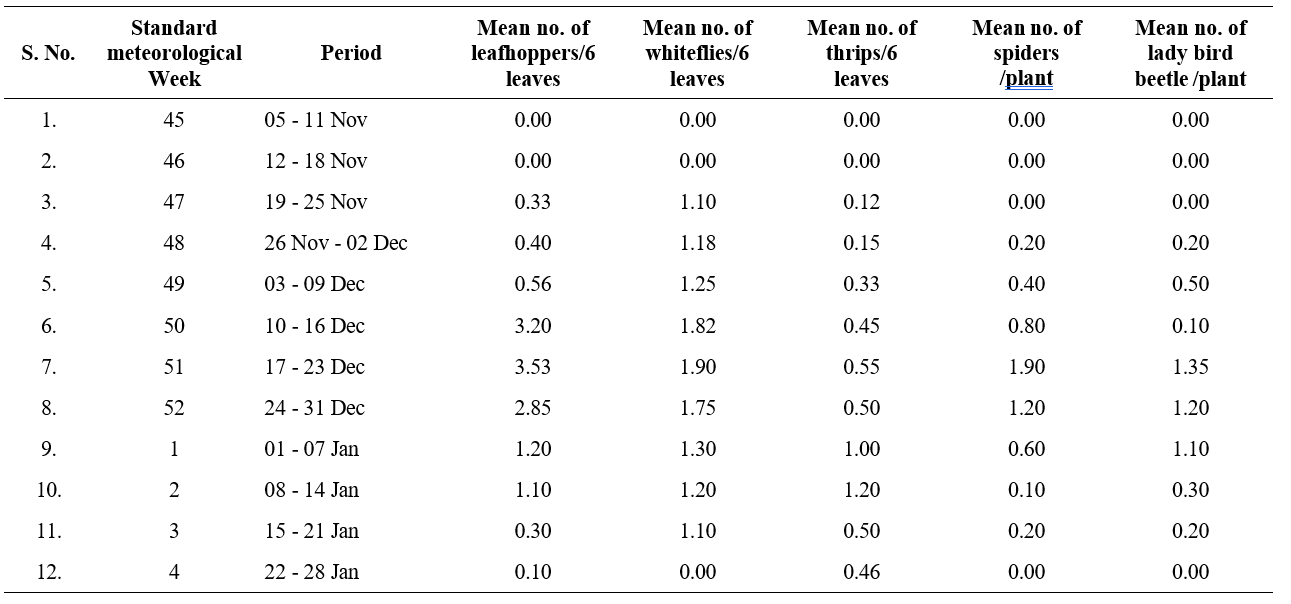
During the period of investigation, the population of insect pest was fluctuating and present throughout the crop season. Population buildup of insect pests and the influence of several weather parameters on their population were presented in the Table 1.
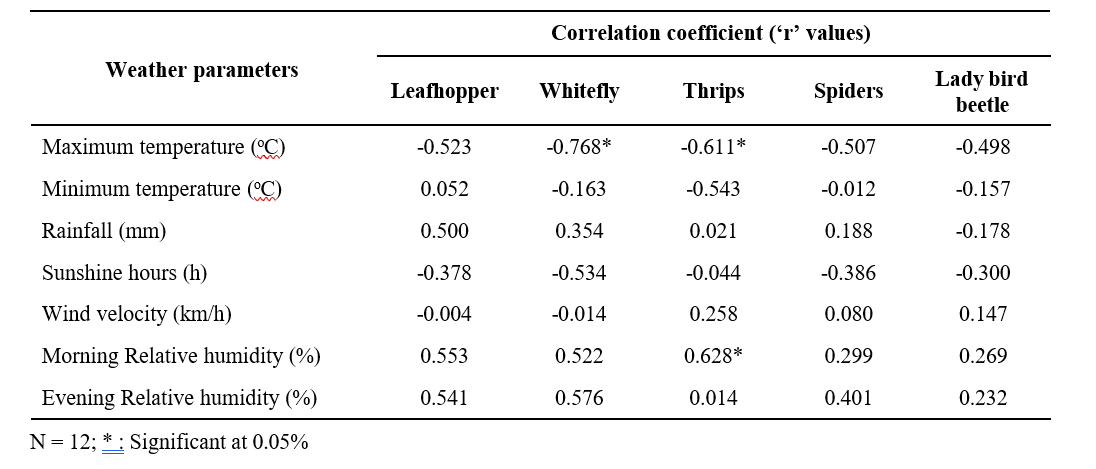
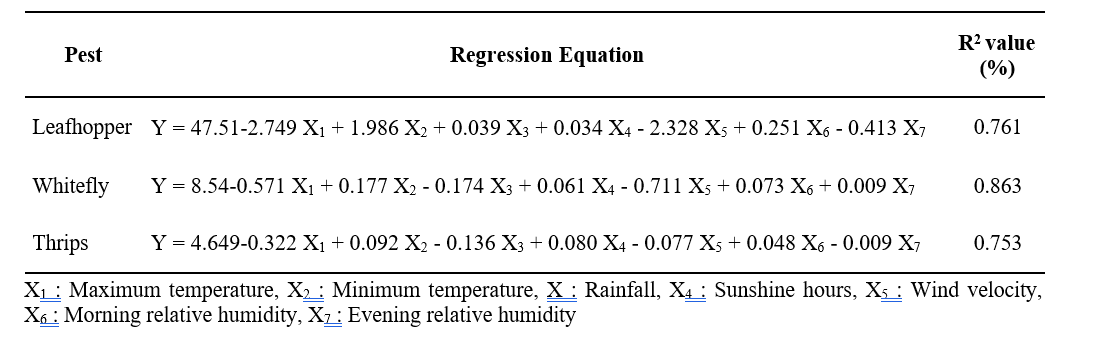
Simple correlation and regression equation of sucking pests and their natural enemies with maximum and minimum temperature, morning and evening relative humidity, rainfall, sunshine hours and wind velocity are presented in the Table 2 and Table 3.
Leafhopper was observed during 47th SMW and maximum population (3.53 per 6 leaves per plant) was observed during the 51st SMW i.e. 3rd week of December (Table 1). The results are in accordance with mean incidence of leafhopper ranging from 0.25 to 1.65 per 6 leaves per plant in sunflower was reported during 43rd and 45th SMW by Geetha and Hegde (2018). Ghante et al. (2020) noticed the peak population of leafhopper observed during 3rd SMW (January). Similarly, the results were obtained by Darandale et al. (2015) who stated that, jassids incidence started to appear from 2nd week of December and peak population of jassids recorded during 4th week of January in niger crop.
Leafhopper population was negatively correlated with maximum temperature(r=-0.523), sunshine hours(r=-0.378) and wind velocity(r=-0.004), whereas positively correlated with rest of the weather parameters (Table 2). Similar results were obtained by Bhura et al. (2020) who reported negative correlation between leafhopper population and maximum temperature. The results are in contrary with the findings of Yadav et al. (2022) who reported negative correlation between leafhopper population and maximum and minimum temperature, rainfall and evening relative humidity. The present results are in conformity with the findings of Kumar and sharma (2023) who reported leafhopper population was showed significant positive correlation with evening relative humidity and rainfall. Shambhavi et al. (2023) who reported that leafhopper population positively correlated with morning and evening relative humidity in castor crop. Similar results were obtained by Sharma et al., (2023) who reported negative correlation between leafhopper population and evening relative humidity, wind speed. The findings were consistent with those observed in previous studies by Nayak et al., (2022) who reported that jassids negatively correlated with maximum and minimum temperature in sunflower
crop.
The multiple linear regression equation for leafhopper is Y=47.51-2.749 X1 +1.986 X2 +0.039 X3
+0.034X4 -2.328 X5 +0.251 X6 -0.413 X7 indicated one unit increase in maximum temperature, wind velocity and evening relative humidity caused increase in leafhopper population by 2.749, 2.328 and 0.413 units. Leafhopper population was collectively influenced by the weather factors to the extent of 76.1 percent (Table 3).
Whitefly was observed during 47th SMW i.e. last week of November, 2024 and active until 4th SMW i.e. last week of January. Highest population (1.90 per 6 leaves per plant) was observed during the 51st SMW i.e. 3rd week of December (Table 1). Similarly, Jadhao et al. (2015) who reported that peak incidence of whitefly recorded during 09th SMW (2.7 nymphs per leaf).
The Population of whitefly significantly negative correlation with maximum temperature(r=-0.768) and non-significantly negative correlation with minimum temperature(r=-0.163), sunshine hours(r=-0.534) and wind velocity(r=-0.014), while positive correlation with rest of the weather parameters (Table 2). Whiteflies found to have non-significant correlation with weather factors (Solanki and Jha 2018). Similarly, the results are also in agreement with Vishwakarma et al., (2023) who reported that population of whitefly in niger crop and showed negative correlation with maximum temperature, minimum temperature, morning and evening relative humidity, while positive correlation with rainfall, wind speed. The same results were conformed with Panday et al., (2019) who reported that positive correlation between whitefly population and minimum temperature and sunshine hours in niger crop. Similar, to the present study Sharma et al., (2023) who reported that whitefly population positively correlation with morning relative humidity. The results were in close agreement with Bhura et al., (2020) who reported positive correlation between whitefly population and evening relative humidity and minimum temperature. The findings were in accordance with Nayak et al., (2022) who reported that whitefly population negatively correlated with maximum and minimum temperature in sunflower crop.
The multiple linear regression equation for whitefly is Y=8.54 -0.571 X1 +0.177 X2 -0.174 X3 +0.061 X4
-0.711 X5 +0.073 X6 +0.009 X7 revealing that an unit increase in maximum temperature, rainfall and wind velocity will increase in whitefly population by 0.571, 0.174 and 0.711 units. Collectively influence of weather factors on population of whitefly was to the tune of 86.3 per cent (Table 3).
Thrips population was observed during 47th SMW and active until 4th SMW. Maximum population of thrips (1.20 per 6 leaves per plant) was observed during
2nd SMW (Table 1). The findings were consistent with those observed in previous studies by Ahir et al., (2017) who reported thrips attained peak during 2nd week of September. Similarly, to the present study Sharmila et al., (2020) reported that peak population of thrips observed during 36th SMW (6.61 thrips per plant).
Thrips population was significantly positive correlation between morning relative humidity (r=0.628) and non-significantly positive correlation with rainfall (r=0.021), wind velocity (r=0.258) and evening relative humidity (r=0.014), whereas negative correlation with maximum temperature (r=-0.611), minimum temperature (r=-0.543) and sunshine hours (r=-0.044) (Table 2). The results were in close agreement with Vijaykumar et al., (2022) who reported that thrips population positively correlated with evening relative humidity and negatively correlated with maximum and minimum temperature, rainfall. The same results were conformed with Saritha et al., (2020) who reported thrips population negatively correlated with rainfall and humidity. Similarly, Ram et al., (2025) who reported that thrips population negatively correlated with sunshine hours, wind velocity and morning and evening relative humidity. The results are conformity with the findings of Ahir et al., (2017) who reported that thrips population negatively correlated with temperature and positively correlated with relative humidity.
The multiple linear regression equation for thrips is Y = 4.649 -0.322 X1 + 0.092 X2 -0.136 X3 + 0.080
X4 – 0.077 X5 +0.048 X6 -0.009 X7 revealing that an unit increase in maximum temperature, rainfall, wind velocity and evening relative humidity will increase in thrips population by 0.322, 0.136, 0.077 and 0.009 units. Collectively influence of weather factors on population of thrips was to the tune of 75.3 per cent (Table 3).
Spider population was observed during 48th SMW and highest population (1.90 per plant) was observed during 51st SMW (Table 1). Spider population was negative correlation with maximum temperature(r=-0.507), minimum temperature(r=-0.012) and sunshine hours(r=-0.386) and positive correlation with rest of the weather parameters (Table 2). The results were in close agreement with Vijaykumar et al., (2022) who reported that spider population negatively correlation with maximum temperature and positively correlated with rainfall morning and evening relative humidity. The results are conformity with the findings of Nayak et al., (2022) who reported spider showed negative correlation with maximum relative humidity and minimum relative humidity.
Lady bird beetle was observed during 48th SMW and was found to be active until 3rd SMW. Maximum population (1.35 per plant) was observed during 51st SMW (Table 1). Rambihari et al., (2015) noticed the peak activity of ladybird beetle on soyabean during 2nd week of August and September with 0.4 grub and adult per plant. Lady bird beetle was found to have non-significantly positive correlation with wind velocity(r=0.147), morning(r=0.269) and evening relative humidity(r=0.232) and Negative correlation with rest of the weather parameters (Table 2). Similarly, Gocher and Ahmad (2019) who reported that positive correlation between ladybird beetle and relative humidity. The results were in close agreement with Kashyap et al., (2018) who reported ladybird beetle positively correlated with rainfall. The findings were consistent with those observed in previous studies by Vijaykumar et al., (2022) who reported that coccinellid population was negative correlation with minimum temperature, maximum temperature, rainfall, morning and evening relative humidity. The findings were consistent with those observed in previous studies by Suyal et al., (2018) who reported Coccinella septempunctata exhibited a positive correlation with evening relative humidity.
The incidence of sucking pest viz., leafhopper, whitefly, thrips was first appeared 15 days after germination. Peak incidence of sucking pests was recorded in 51st and 2nd standard week. The correlation studies on leafhopper, whitefly and thrips showed negative correlation with maximum temperature, minimum temperature, sunshine and wind velocity, but positive correlation with rainfall, morning and evening relative humidity. Natural enemies like spiders and ladybird beetles positively correlated with wind velocity, morning and evening humidity, while negatively correlated with maximum and minimum temperature, rainfall and sunshine hours.
Ahir, K.C., Saini, A., Rana, B.S and Dangi, N.L. 2017. Population dynamics of sucking pests in relation to weather parameters in groundnut (Arachis hypogaea L.). Journal of Entomology and Zoology Studies. 5(2): 960-963.
Basappa, H. 2004. Integrated pest management in sunflower, an Indian scenario. Proc. 16th International sunflower conference. Fargo. ND USA. (pp. 853-859)
Bhura, S., Singh, P., Yadav, A.S and Bhadauria, N.S. 2020. Seasonal Incidence of Insect-pests Complex of Sesame (Sesamum indicum L.). International Journal of Current Microbiology and Applied Sciences. 9(12): 266-273.
Darandale, S.A., Pandya, H.V., Patel, S.D and Patel, S.M. 2015. Population dynamics of major sucking pests infesting niger and their relation to weather parameters. International Journal of Plant Protection. 8(1):61-64.
Geetha, S and Hegde, M.G. 2018. Incidence of insect pests and natural enemies in sunflower crop ecosystem.
International Journal of Current Microbiology and Applied Sciences. 7(9): 1593-1601.
Ghante, V.N., Umesh M.R., Shantappa D and Vikas K. 2020. Influence of weather parameters on population of whitefly (Bemisia tabaci) in sunflower. Journal of Entomology and Zoology Studies. 8(6): 1729-1734.
Gocher, S and Ahmad, S. 2019. Seasonal incidence of major sucking insect pests of groundnut in relation to weather parameters of semi-arid region of India. International Journal of Current Microbiology and Applied Sciences. 8(08): 1106-1111.
Heiser, C.B. 1951. The sunflower among the North American Indians. Proceedings of American Philosophical Society. 95(4): 432-448.
Indiastatagri 2023. https://www.indiastatagri.com/ Jadhao, S.M., Shetgar, S.S and Bhamare, V.K. 2015.
Population dynamics of sucking insect-pests infesting sunflower and its relationship with weather parameters. Annals of Plant and Soil Research. 17(6): 486-488.
Kakakhel, S.A., Islam, N., Amjad, M and Malik, M.K. 2000. Insect-pests complex of sunflower, Helianthus annuus L. Pakistan Journal of Biological Sciences. 3(4): 669-671.
Kashyap, N., Painkra, G.P., Painkra, K.L and Bhagat, P.K. 2018. Insect-pests succession, natural enemies and their correlation with weather parameters in mustard crop. Journal of Plant Development Sciences. 10(10): 563-568.
Kumar, N and Sharma, M.L. 2023. Seasonal incidence of major insect pests of sesame. Indian Journal of Entomology. 85(1): 201-204.
Nayak, S.K., Khura, N and Moharana, R.L. 2022. Seasonal abundance of insect pest and natural enemies in sunflower in the Western undulation zone of Odisha. The Pharma Innovation Journal. 11(5): 245-248.
Panday, A.K., Bisen, R. Jain, S and Sahu, R. 2019. Effect of climatic factors on population intensity of insect pests damaging niger crop. International Plant Protection Congress. Hyderabad, Telangana. 278.
Patel, H.R and Shekh, A.M. 2006. Pest epidemics and role of meteorological services: An overview.
Journal of Agrometeorology. 8:104-113. Ram, A.A., Baraiya, K.P and Solanki, B.J. 2025. Seasonal incidence of sucking pest complex in sesamum (Sesamum indicum L.). Plant Archives. 25(1): 782-786.
Rambihari, A., Payal, D and Rajeev, G. 2015. Seasonal incidence of major insect pests and their biocontrol agents of soybean crop (Glycine max L. Merrill). Scientific Research and Essays. 10(12): 402-406.
Saritha, R., Sirisha, A.B.M., Haseena, S.K and Sujatha, 2020. Impact of weather on incidence of sucking pests in groundnut. Journal of Entomology and Zoology Studies. 8(3):1157-1163.
Shambhavi, H.T., Srinivas Reddy, K.M., Yamanura, M. K.R., Reddy, K and Katteppanavar, A.D. 2023. Population dynamics of insect pests of castor. The Pharma Innovation Journal. 12(5): 112-118.
Sharma, A.P., Sonkamble, M.M., Channe C.B., Matra, N.G and Randive, D.B. 2023. Seasonal incidence of sucking pests of the sunflower. Biological forum – An International Journal. 15(10): 1032-1036.
Sharmila, Y., Rani, C.S., Chiranjeevi, C and Kumar, P.A. 2020. Influence of abiotic factors on the seasonal incidence of sucking pests and occurrence of natural enemy population in groundnut ecosystem. The Andhra Agricultural Journal. 67(1): 61-66.
Solanki, R.D and Jha, S. 2018. Population dynamics and biology of whitefly (Bemisia tabaci Gennadius) on Sunflower (Helianthus annuus L.). Journal of Pharmacognosy and Phytochemistry. 7(1): 3055-3058.
Suyal, P., Gaur, N., Rukesh, P.K.N and Devrani, A. 2018. Seasonal incidence of insect pests and their natural enemies on soybean crop. Journal of Entomology and Zoology Studies. 6(4): 1237-1240.
Vijaykumar N. Ghante, Poornima, Vikas V.K and Umesh M.R. 2022. Present Status of Sunflower Pests and their Natural Enemies in North Karnataka. Biological Forum – An International Journal. 14(4): 220-224.
Vishwakarma, D., Panday, A. K and Jain, S. 2023. Study the Population Dynamics of Major Insect Pest of Niger (Guizotia abyssinica) Crop. International Journal of Plant Soil Science. 35(19): 1231-1234.
Yadav, S., Yadav, J and Dahiya, P. 2022. Population dynamics of major insect pests of castor, Ricinus communis L. as influenced by weather variables in south-west Haryana. Indian Journal of Ecology. 49(4): 1456-1463.
Zafar, K, Suhail, A, Arshad, M and Jalal, A.M. 2013. Impact of weather factors on population fluctuation of H. armigera on Sunflower. Pakistan Journal of Nutrition. 12(1):50-54.