

0 Views
Department of Soil Science, S.V. Agricultural College, ANGRAU, Tirupati-517 502.
An investigation was carried on “Impact of conjunctive use of organic and inorganic fertilizers on nutrient availability in soil, yield and yield attributes of maize (Zea mays L.)” during kharif 2024 at wet land farm of S.V. Agricultural College, Tirupati. The experiment was carried out in randomized block design with three replications consisting of ten treatments with 75% and 100% RDF along with poultry manure, FYM and microbial inoculum (Azospirillum, PSB and KSB). Data indicated that application of 100% RDF + Soil application of liquid biofertilizers viz., Azospirillum, PSB and KSB @ 1.25 litres ha-1 each (T5) resulted in the highest grain yield and stover yield. Yeild attributes like cob length, number of kernels per row, number of kernel rows per cob were found to be highest with application of 100% RDF + soil application of liquid biofertilizers viz., Azospirillum, PSB and KSB @ 1.25 litres ha-1 each (T5). The highest available nutrients viz., N, P, K were noticed with application of 100% RDF + Soil application of liquid biofertilizers viz., Azospirillum, PSB and KSB @ 1.25 litres each (T5).
KEYWORDS: Liquid Biofertilizers, kernel, yield, growth.
Maize belongs to family Gramineae and popularly known as corn. Maize is the third most consumed cereal after rice and wheat. It is commonly called as the queen of cereals due to its high genetic yield potential compared to the other cereals. Maize is cultivated on nearly 190 million hectares in about 165 countries, which have a wide diversity of soil, climate, biodiversity, and management practices. India stands at sixth position in productivity with 3 metric ton per hectare. Maize is primarily grown in the Kharif season nearly contributing 85 per cent of cultivation during this season. In India major producing states of maize are Maharashtra, Madhya Pradesh and Karnataka. Among the maize-producing states, Andhra Pradesh ranks 13th in cultivation area with 2.91 lakh hectares and is estimated to produce 19.04 lakh tonnes contributing to 5.34% of India’s total production, with a productivity of 6543 kg ha-1 (Maize Outlook Report, ANGRAU).
Maize is highly nutrient exhaustive crop requires higher amounts of both macro and micro nutrients to obtain higher yields. Inorganic fertilizers are costly and its continuous usage causes nutrient imbalance, lowers the nutrient use efficiency, deteriorates soil properties and causes drastic fall in soil fertility. Therefore, conjunctive use of fertilizers i.e., chemical fertilizers, organic manures and biofertilizers together in crop production is gaining importance for sustainable food production. It helps to achieve higher crop productivity, prevents soil degradation thus helping to meet future food supply.
A field experiment entitled” Impact of conjunctive use of organic and inorganic fertilizers on nutrient availability in soil, yield and yield attributes of maize (Zea mays L.)” was conducted during kharif, 2024 on sandy clay loam soils of wetland farm of S.V. Agricultural College, Tirupati campus of Acharya N.G. Ranga Agricultural University. Geographically situated at 13°36’55.3″N latitude and 79°22’20.2″E longitude with an altitude of 182.9 m above mean sea level, which falls under Southern Argo Climatic Zone of Andhra Pradesh.
The experiment was laid out in randomized block design with three replications consisting of ten treatments. The field was ploughed and given pre-sowing irrigation. The field was divided into 30 different plots of 6m x 5m size. FYM and poultry manure are applied seven days before sowing. The pretreated seed of variety Kaveri 50 was sown by dibbling method in between the
rows by using maize seed at the rate of 8 kg per hectare with a spacing of 60cm x 20cm on 25th July, 2024. RDF (Recommended dose of fertilizer) of NPK for maize was 200:60:50 kg ha-1. Nitrogen was applied in the form of urea in two splits, first split at the time of sowing and second split at 30 DAS. Phosporus was applied in the form of SSP and potassium as MOP as a basal dose. Regular biometric observations were recorded at periodic intervals of 30 DAS, 60 DAS, 90 DAS and at harvest stages. Yield attribute parameters were recorded just before harvesting of crop.
The initial and post-harvest soil samples were collected from the experimental field and analysed for soil texture by International pipette method as described by Piper (1966), pH and EC by Conductometry as described by Jackson (1973), organic carbon percent by Wet digestion method as described by Walkley and Black (1934), N by Alkaline permanganate method as described by Subbiah and Asija (1956), P2O5 by Olsen’s extraction as described by Olsen et al., (1954), K2O by Neutral normal ammonium acetate as described by extraction Jackson (1973).
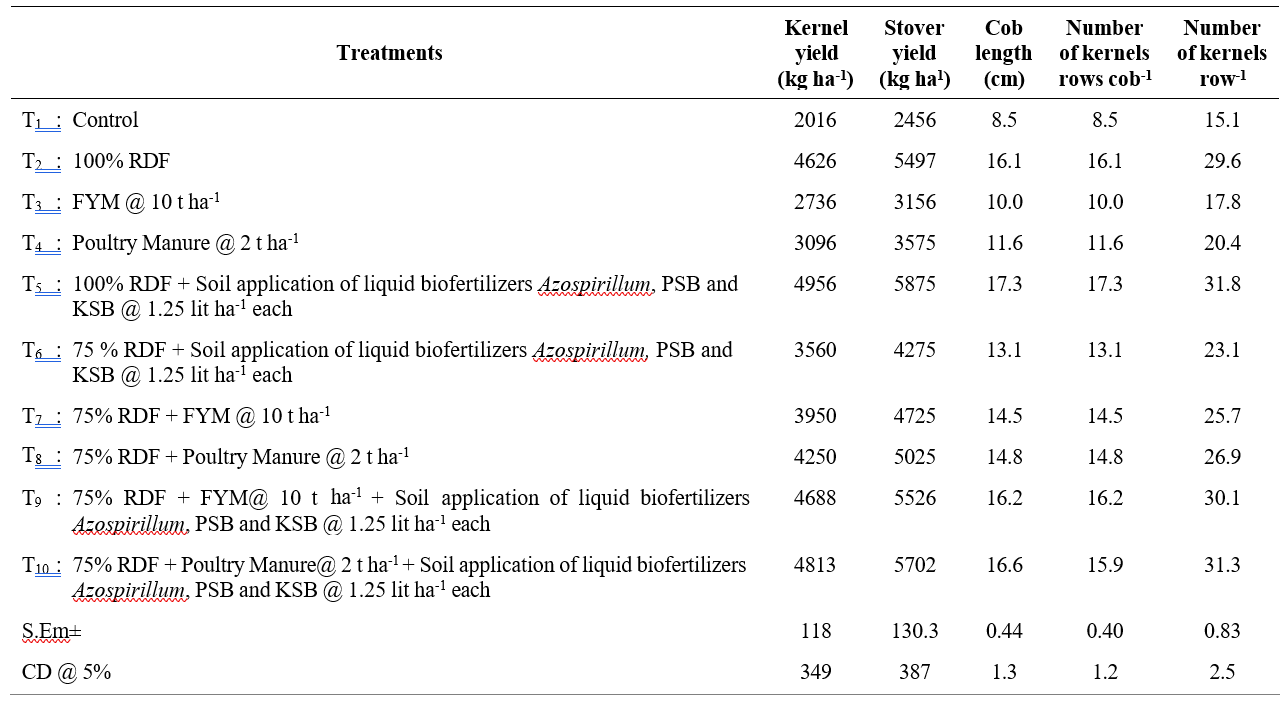
Data depicted in Table.1. showed high kernel yield and stover yield were recorded with the application of 100 % RDF + soil application of liquid biofertilizers Azospirillum, PSB and KSB @ 1.25 litres ha-1 each (T5) which was on par with application of 75 % RDF + poultry manure @ 2 t ha-1 + soil application of liquid biofertilizers Azospirillum, PSB and KSB @ 1.25 litres ha-1 each (T10), 75 % RDF + FYM @ 10 t ha-1 + soil application of liquid biofertilizers Azospirillum, PSB and KSB @ 1.25 litres ha-1 each (T9) and 100 % RDF (T2). The lowest kernel yield was recorded in the control (T1). Combining of fertilizers with biofertilizers improved nitrogen and phosphorus availability to maize. This led to better root growth, nutrient uptake, and plant development. Overall, the integration resulted in higher kernel and stover yields. (Jat et al., 2014).
Yield attributes like highest cob length, number of kernels per row, number of kernel rows per cob were highest with the application of 100 % RDF + soil application of liquid biofertilizers Azospirillum, PSB and KSB @ 1.25 litres ha-1 each (T5) which was on par with application of 75 % RDF + poultry manure @ 2 t ha-1+ soil application of liquid biofertilizers Azospirillum, PSB and KSB @ 1.25 litres ha-1 each (T10), 75 % RDF + FYM @ 10 t ha-1 + soil application of liquid biofertilizers Azospirillum, PSB and KSB @ 1.25 litres ha-1 each (T9) and 100 % RDF (T2). The lowest yield attributes were recorded in the control (T1). The improvement in yield traits under integrated use of fertilizers with biofertilizers might be due to higher absorption of nutrients responsible for increased photosynthate accumulation and high biomass production and finally resulting in increase in the yield components. (Naik et al., 2020).
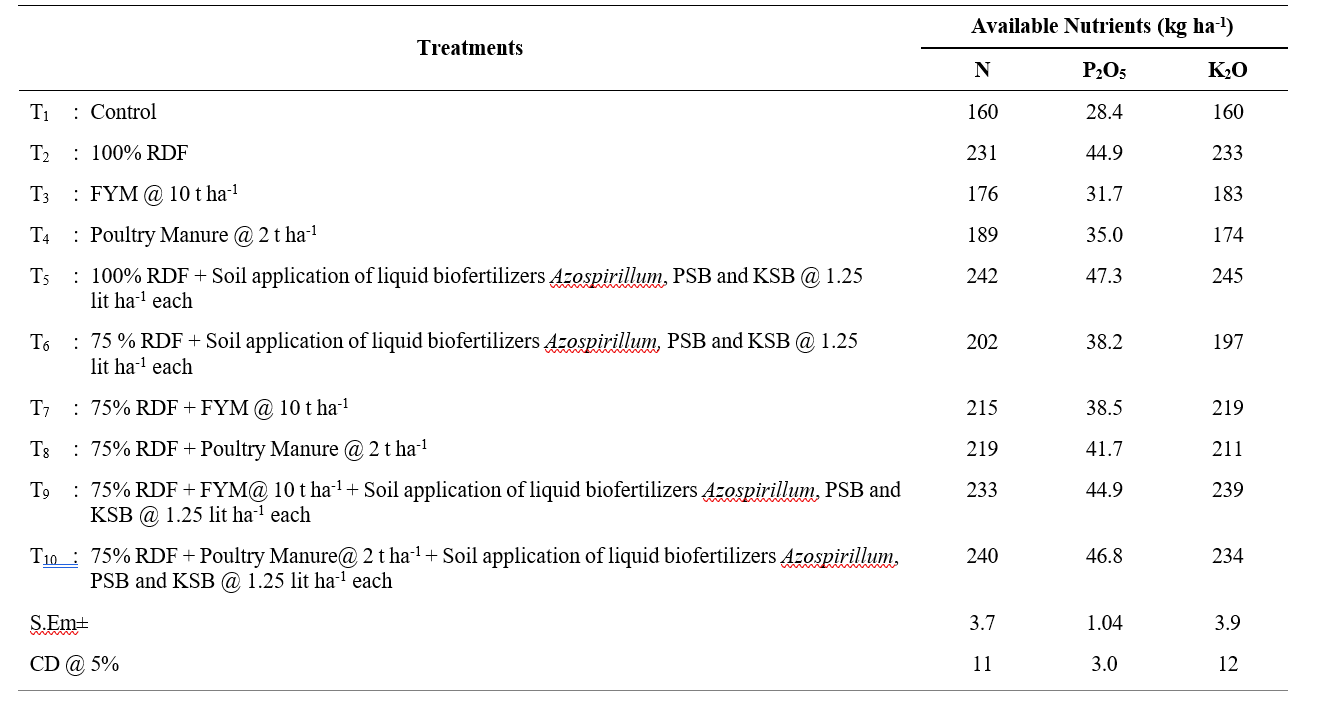
Available nitrogen, phosphorous and potassium as depicted in Table.2. were found to be highest with the application of 100 % RDF + soil application of liquid biofertilizers Azospirillum, PSB and KSB @ 1.25 litres ha-1 each (T5) which was on par with application of 75% RDF + poultry manure @ 2 t ha-1 + soil application of liquid biofertilizers Azospirillum, PSB and KSB @ 1.25 litres ha-1 each (T10), 75 % RDF + FYM @ 10 t ha-1+ soil. Application of liquid biofertilizers Azospirillum, PSB and KSB @ 1.25 litres ha-1 each (T9) and 100 % RDF (T2). The lowest available nitrogen, phosphorous and potassium were recorded in the control (T1).
The reason for high nutrient content in 75 % RDF+ poultry manure @ 2 t ha-1 + soil application of liquid biofertilizers Azospirillum, PSB and KSB @ 1.25 litres ha-1 each (T10) might be due to the addition of organic matter through the manures & added biofertilizers resulted in increase in microbial population that regulates soil temperature, soil moisture and humus content in soil. This might have created favourable soil environment for microbes favouring their rapid multiplication and ultimately increasing nutrient availability. (Sudhakar et al., 2019. Combined application of organic and inorganic sources reduces will definitely improve soil nutrient status. (Maish et al., 2018)
It can be concluded that , integrated application of inorganic fertilizers, organic manures and biofertilizers played an important role in improving the N,P and K availability to the plants. Combined application of 100% RDF + Soil application of liquid biofertilizers viz., Azospirillum, PSB and KSB @ 1.25 litres ha-1 each (T5) resulted in highest yield and yield attributes.
Acharya N.G. Ranga Agricultural University (ANGRAU). 2023. Maize outlook report: 2023–24. Agricultural Market Intelligence Centre, ANGRAU. https:// angrau.ac.in/ANGRU/Agricultral-Market- Intelligence.aspx
Naik, B.P., Kumari, A.L., Subbaiah, P.V and Luther, M.M. 2020. Effect of liquid biofertilizers on growth and yield of direct sown rice. The Andhra Agricultural Journal. 67(3): 194-196.
Jackson, M.L. 1973. Soil Chemical Analysis. Prentice Hall of India Private Limited, New Delhi. 32-33.
Jat, P.C., Rathore, S.S and Sharma, R.K. 2014. Effect of integrated nitrogen management and intercropping systems on yield attributes and yield of maize. Indian Journal of Hill Farming. 27(1): 52-56.
Maish, S., Odhiambo, J.J., Mnkeni, P.N.S and Muchaonyerwa, 2018. Effects of integrated use of organic and inorganic nutrient sources on maize productivity and soil properties in sub-Saharan Africa: A review. Soil and Tillage Research.183: 1–15.
Olsen, S.R., Cole, C.V., Watanabe, F.S and Dean, L.A. 1954. Estimation of available phosphorus in soil by extraction with sodium Bicarbonate. Circular of United States Department of Agriculture. 939: 19- 23.
Piper, C.S. 1966. Soil and Plant Analysis. Inter Science Publishers, New York. 47-49.
Subbiah, B.V and Asija, G.L. 1956. A rapid procedure for estimation of available nitrogen in soils. Current Science. 25(7): 259-260.
Sudhakar, P., Sakthivel, V., Manimaran, S., Baradhan, G and Kumar, S.S. 2019. Impact of integrated plant nutrient management systems on soil physical properties and productivity enhancement in maize (Zea mays L.). Plant Archieves. 19(1): 309-313.
Walkley, A and Black, I.A. 1934. An examination of the method for determining soil organic matter, and a proposed modification of the chromic acid titration method. Soil Science. 37(1): 29-38.